The interview: Pascal Raffy on Bovet’s latest Récital watches, the materials they’re built from, and what he believes luxury is actually for
by Hamish McDougall
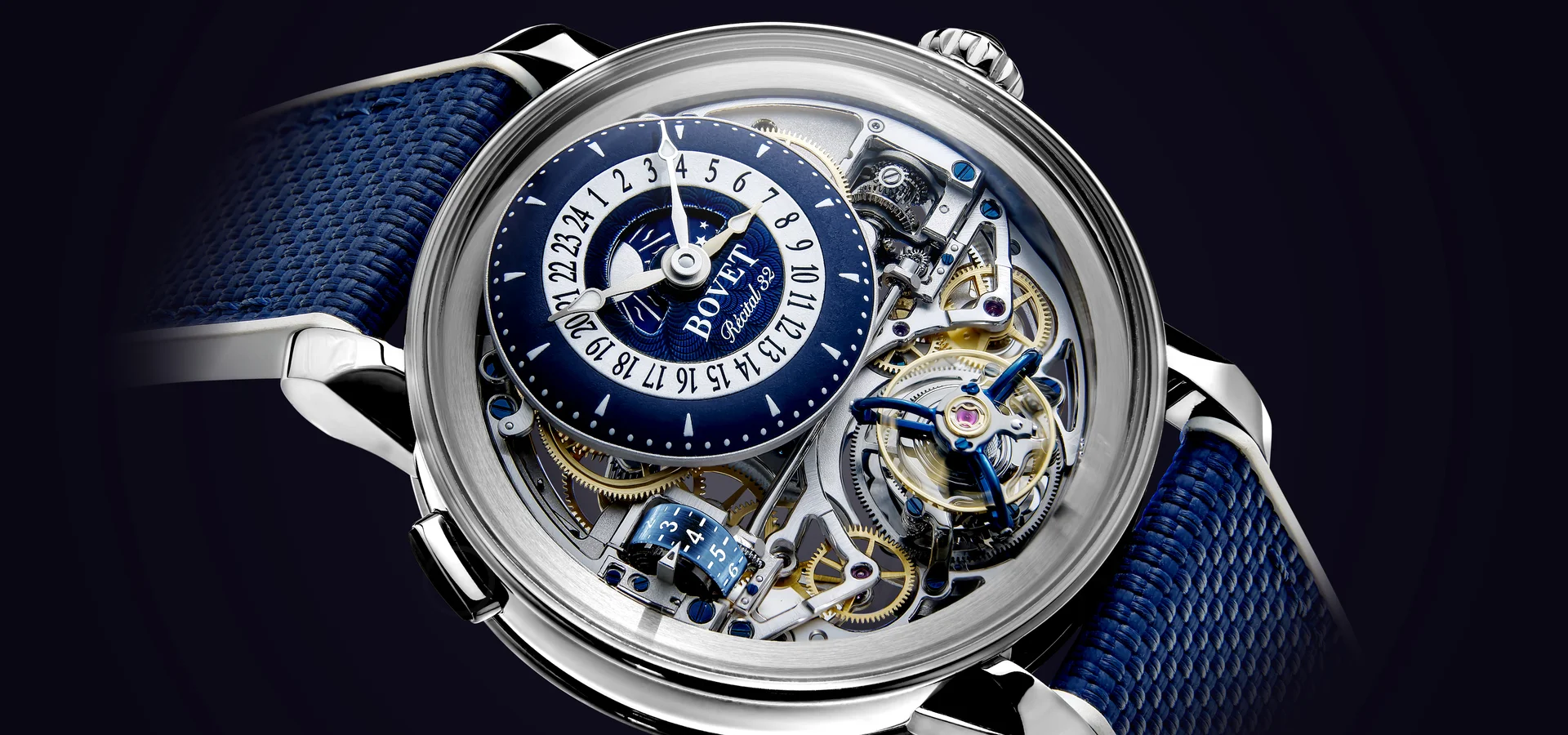
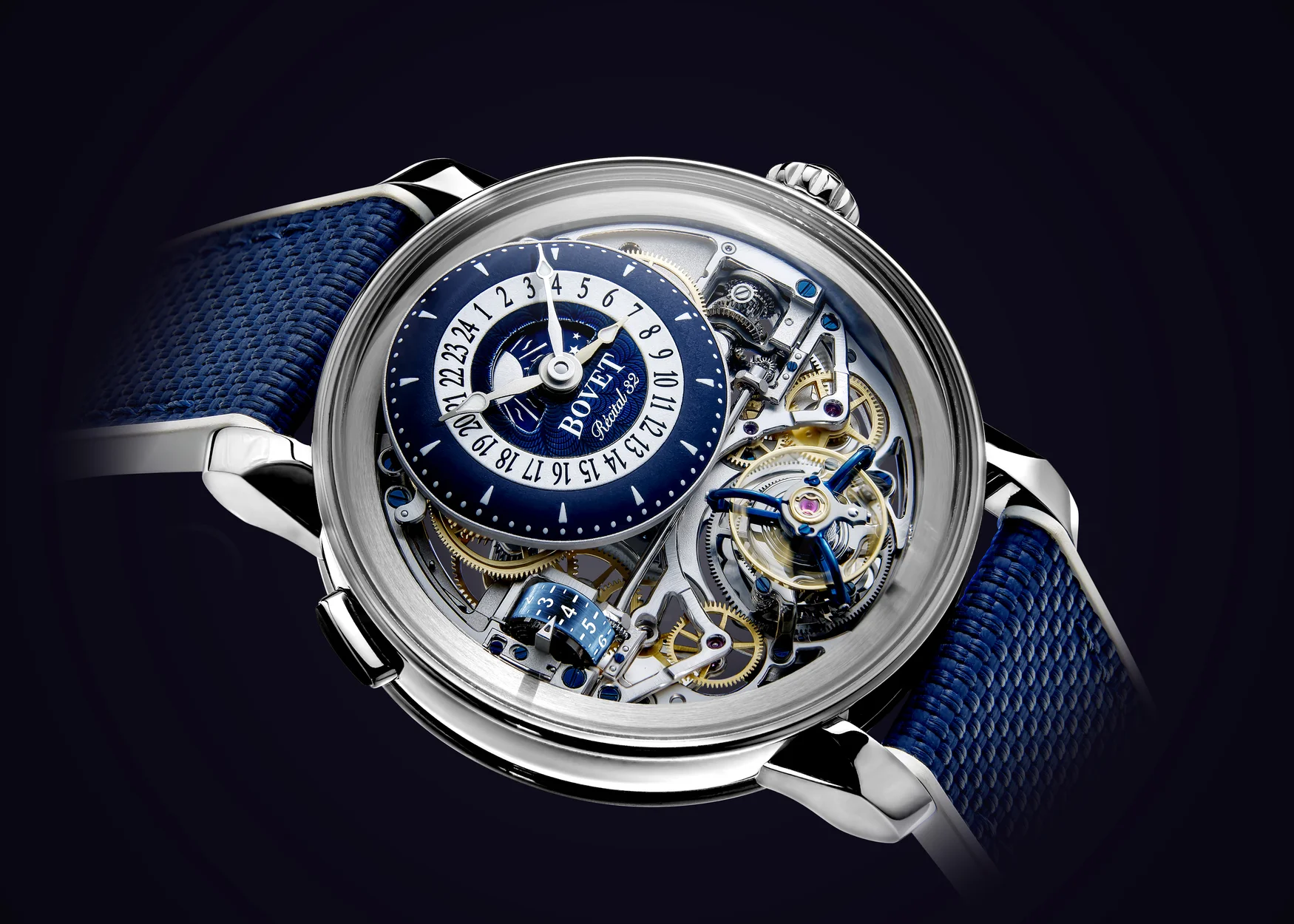
Pascal Raffy does not call the Récital 32 (top) an achievement so much as a promise finally kept—to an idea he had been circling since the Récital 28. “I’d wanted a tourbillon for five years, because a tourbillon is the heart beating,” he says, seated in the room where he has just walked a group of long-standing collectors through Bovet’s newest work. The watch that resulted—a 42mm flying tourbillon with a true GMT and a 10-day reserve—is smaller and quieter than the piece it grew out of, and to Raffy, that is exactly the point.
It is the kind of decision that tells you how Bovet is run. Raffy has owned the maison since 2001, and for a house of 200 years, he keeps it deliberately small: around 1,000 timepieces a year, more than 95 per cent of every component made in-house, and a distribution network he has lately been cutting rather than widening. What ties the newest Récitals together—the 30, 31, and 32, which he reels off like siblings—is not a complication but a discipline. “A lot of collectors tell me the same thing: ‘Pascal, we are getting confused, because so many watches now look nearly the same.’” Continuity, he insists, is the harder trick than novelty.
Why a Bovet has to look like a Bovet
“The move that started with the Récital 30 is very logical, very sustainable,” Raffy says. Where another house might trade on spectacle, Bovet spends—by his account, “days and nights, months, weeks, years”—making each new piece legibly the child of the last. The Récital 32 began as a 40mm sketch and reached 42mm only once his watchmakers found room for a flying tourbillon carriage, a GMT, a power-reserve roller, and a new hand-engraved pattern across the plate and bridges, inside a case shaped deliberately like “a brother of the Récital 30”. Set the two side by side, he says, and one realises “this is the same family.”
That insistence on meaning, rather than novelty for its own sake, is clearest in the Récital 31. Its spherical moonphase is modelled on the moon’s actual surface topography, hand-engraved and then given luminescence so the sunlit face reads white and the hidden one black. The moon circles the earth in 29 days, 11 hours, 44 minutes and eight seconds; Bovet tuned the mechanism to 29 days, 11 hours and 45 minutes, close enough that it loses a single day only once every 122 years. The whole assembly—perpetual calendar, retrograde date, and that moon—is integrated into a 469-component movement in a 44mm case. It is objectively big, he concedes, but the size buys a display large enough to read the indications properly.
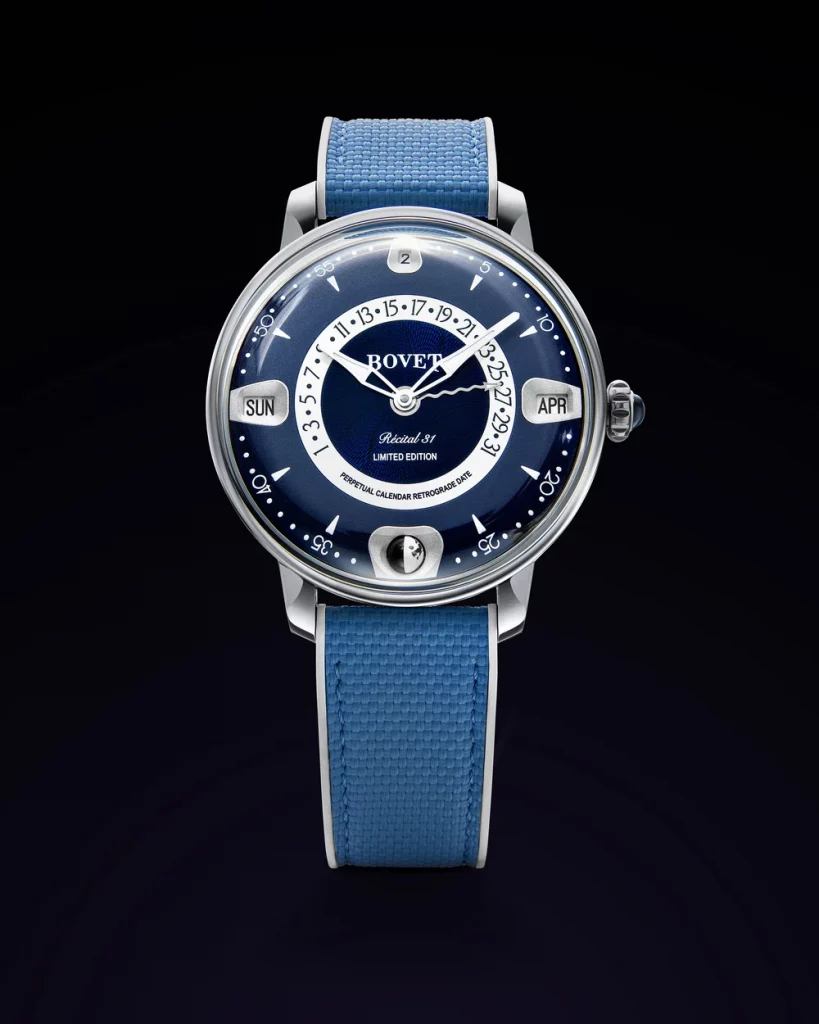
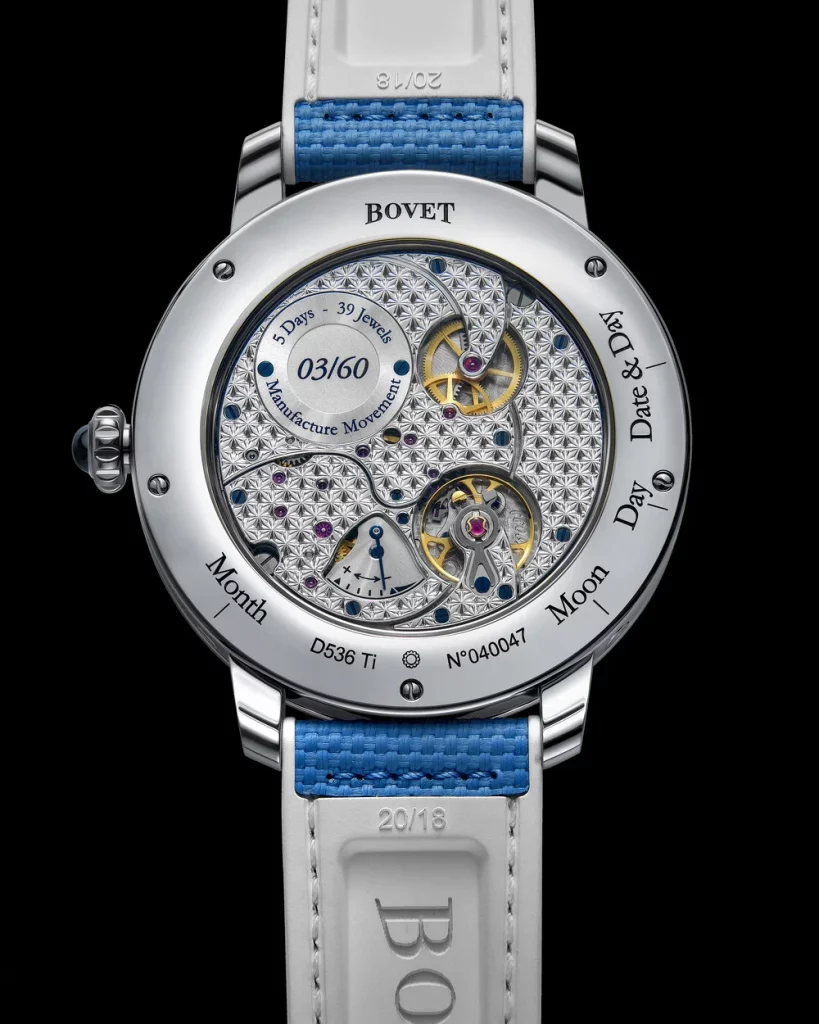
The Récital 31 is a perpetual calendar watch featuring a 44mm Dimier case, a retrograde date, and a spherical moon phase. Top: The Récital 32 is Bovet’s first-ever “true GMT” timepiece, combining an independent second-time-zone complication with an elevated flying tourbillon, a 10-day power reserve, and a wearable 42mm case. (Photos courtesy of Bovet)
Materials, and the meaning of luxury
Raffy loved platinum on the Récital 28—a 744-component “huge machine”—and wore his platinum prototype through every quality test. Then, almost on a whim, he asked his production head Jacques to prepare a second movement in a titanium case. “When I put on the titanium, I said: no more platinum.” The saving was never the reason—“the economy is justified, because it is a big engine”—but the feel of it was. He has carried the logic across the range, and wears his own Récital 32 in polished titanium with a blue dial.
Ask him where luxury sits in a volatile world, and he rejects the premise that it is a matter of spending. “For me, luxury comes down to one word: education,” he says. Collectors read far more than they did 25 years ago, so a claim to make everything in-house has to survive a visit to the factory. His own example is the newest Aperto 1 Bi-Color, the Pininfarina-designed skeleton he chose to leave almost entirely in titanium: only the crown, bezel, and six screws in 18K red gold, and the rest bare mechanism. He could have cased it in gold, he says, “not because of the price of gold, but simply because I could.” He didn’t. Luxury, to him, is a quiet business—a man in a white shirt, jeans, and good shoes wearing a single watch, rather than the one arriving with the car and the bags. “That,” he says, “is boring.”
On value
Raffy is blunt about price. He names no one, but describes watches offered at CHF 800,000 that he believes—“as an expert, because I make my own timepieces”—are worth CHF 400,000, and warns that the speculation holding such numbers up “can be violent” when it falls.
His own arithmetic runs the other way. The solid-gold Récital 32 could sit anywhere in a range up to CHF 225,000; he set it at CHF 175,000. “Let me give the collector a little more than he pays for,” he says. “Because I am building loyalty.” When one collector insisted the watch was really worth CHF 250,000, Raffy told him no.
For a man who trusts his own wrist over any argument on paper, the surprises still land. He tells one against himself: the three hand-engraved limited editions he was sure would linger, because they were focused on handcrafting and traditional metiers d’art, not cutting-edge but throwbacks to timeless works of art. He was wrong; they sold out by the Saturday night in Geneva. “Sometimes we fix ideas in our own heads,” he says. “It is good to listen to others.” From the owner of a 200-year-old house, it sounds less like a concession than a working method.
Go further with the 2026 edition of Watches and Wonders in Geneva.
Read next:
- Bovet’s Pascal Raffy on the 2025 novelties and solving daylight saving time
- The interview: Hautlence co-founder Guillaume Tetu on making watches for fun over investment
More watch and jewellery interviews from Boulevard.
In brief:
The novelty: Bovet owner and CEO Pascal Raffy introduces the Récital 32, the maison’s first true GMT flying tourbillon—a 42mm, 375-component watch he chose to case in titanium rather than platinum—alongside the moon-topography Récital 31.
The maison: Bovet was founded by Edouard Bovet, who left Fleurier to trade in London and then Canton (Guangzhou), building the house’s early fortune on ornate timepieces for the Chinese imperial court. Raffy, a collector who acquired the company in 2001, runs it from the Château de Môtiers in the Val-de-Travers and produces close to 95 per cent of components in-house—cases, dials, hands, and movements—across its Tramelan and Fleurier workshops. The strategy is deliberately anti-scale: roughly 1,000 timepieces a year, and six Grand Prix d’Horlogerie de Genève awards over the past six years, from the Miss Audrey and Récital 20 Asterium to the daylight-saving Récital 28 Prowess 1 and Récital 30.
Collector insights: Raffy has trimmed Bovet’s distribution by 30 per cent after auditing partners, prices the gold Récital 32 at CHF 175,000 despite reasoning it could reach CHF 225,000, and warns openly that speculation on scarce pieces “can be violent” if it unwinds. Titanium versions of the Récital 32 sit at CHF 150,000; the 469-component Récital 31 and the fully hand-engraved 1930 and Monsieur Bovet limited editions occupy the top of the range.
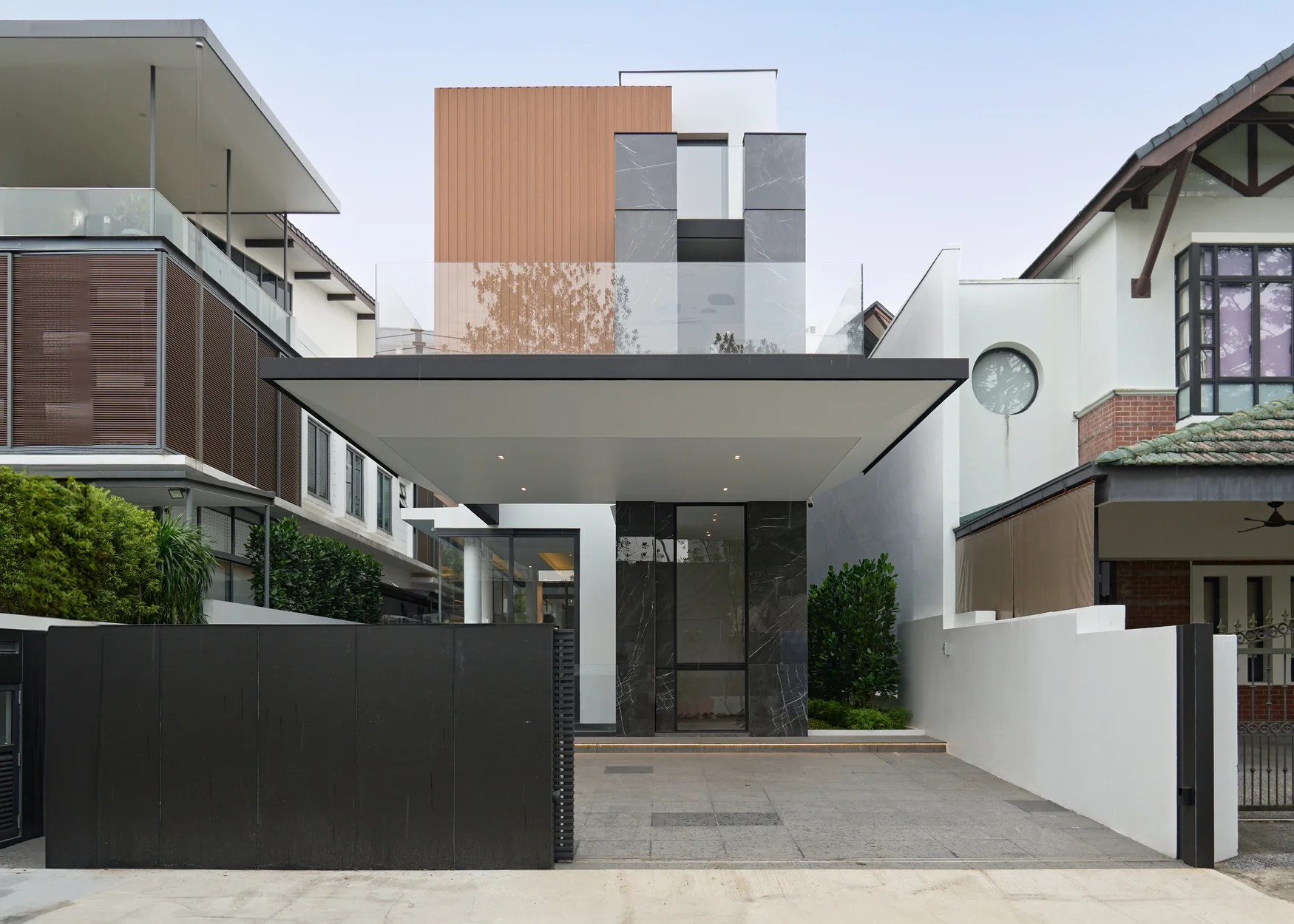
8+1 bed | 10,200 sqft area 19,500,000 SGD
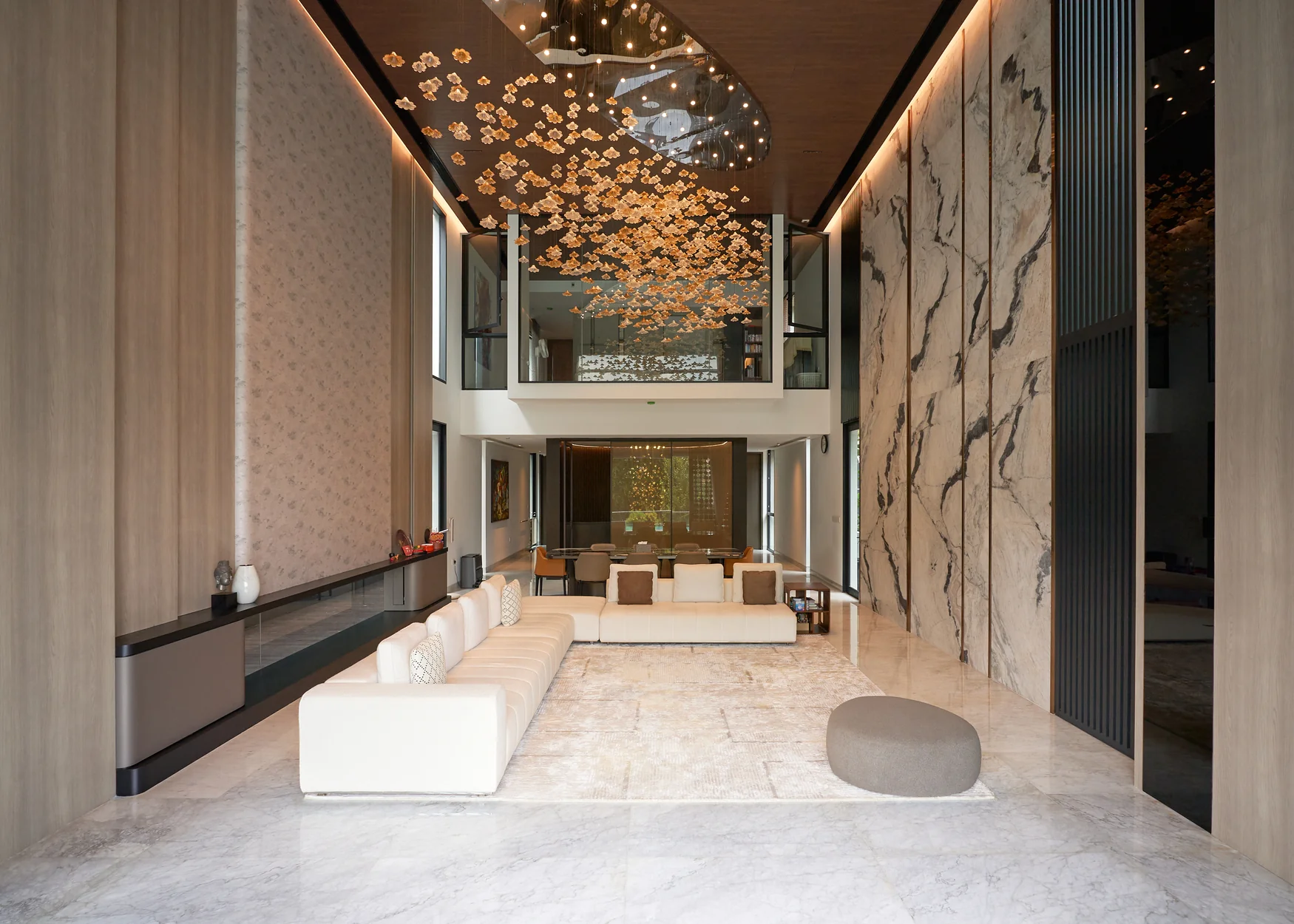
5 bed 19,380,000 SGD
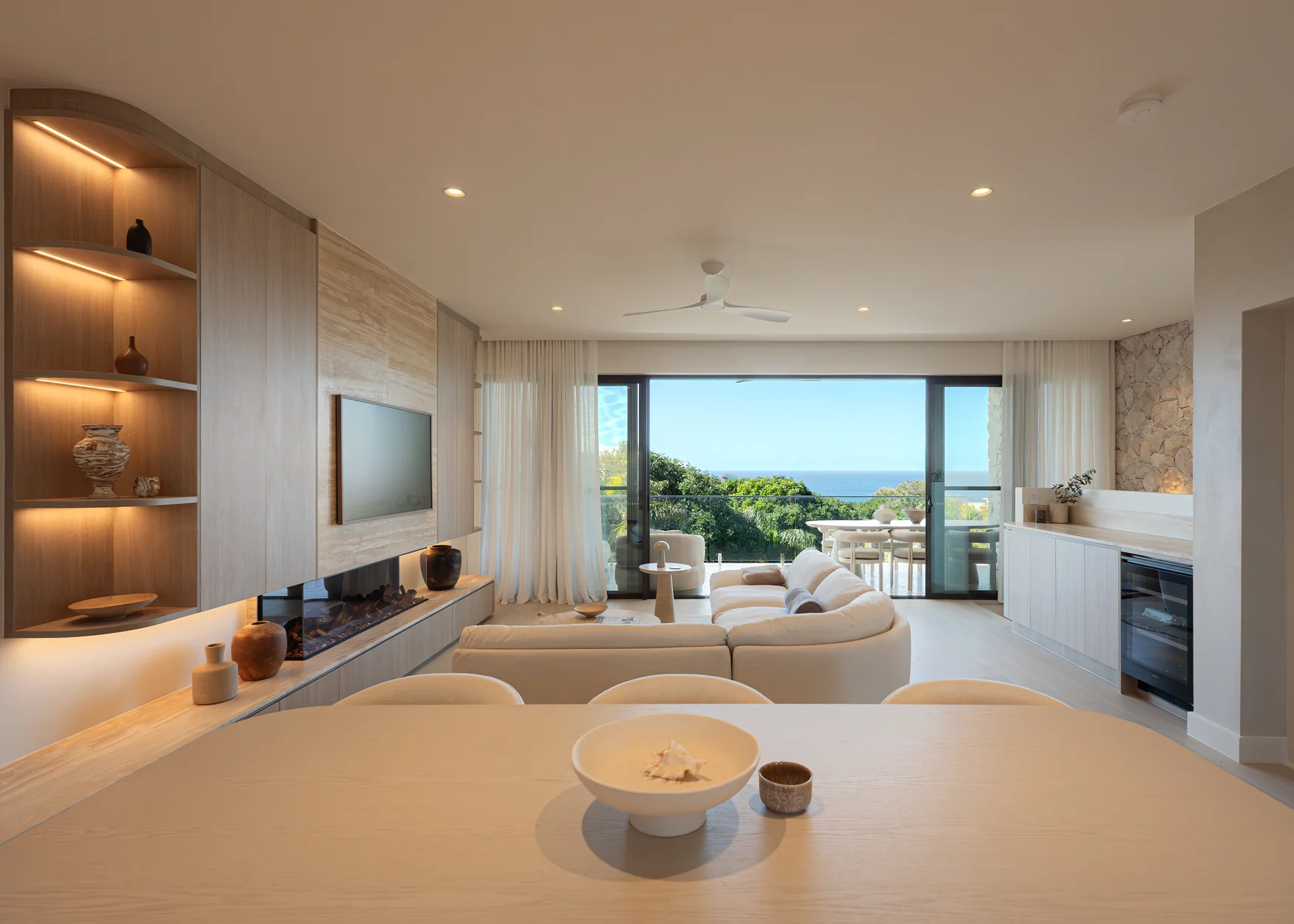
4 bed | 4,208 sqft area POA

3-8 bed | 699,654 - 784,080 sqft area POA
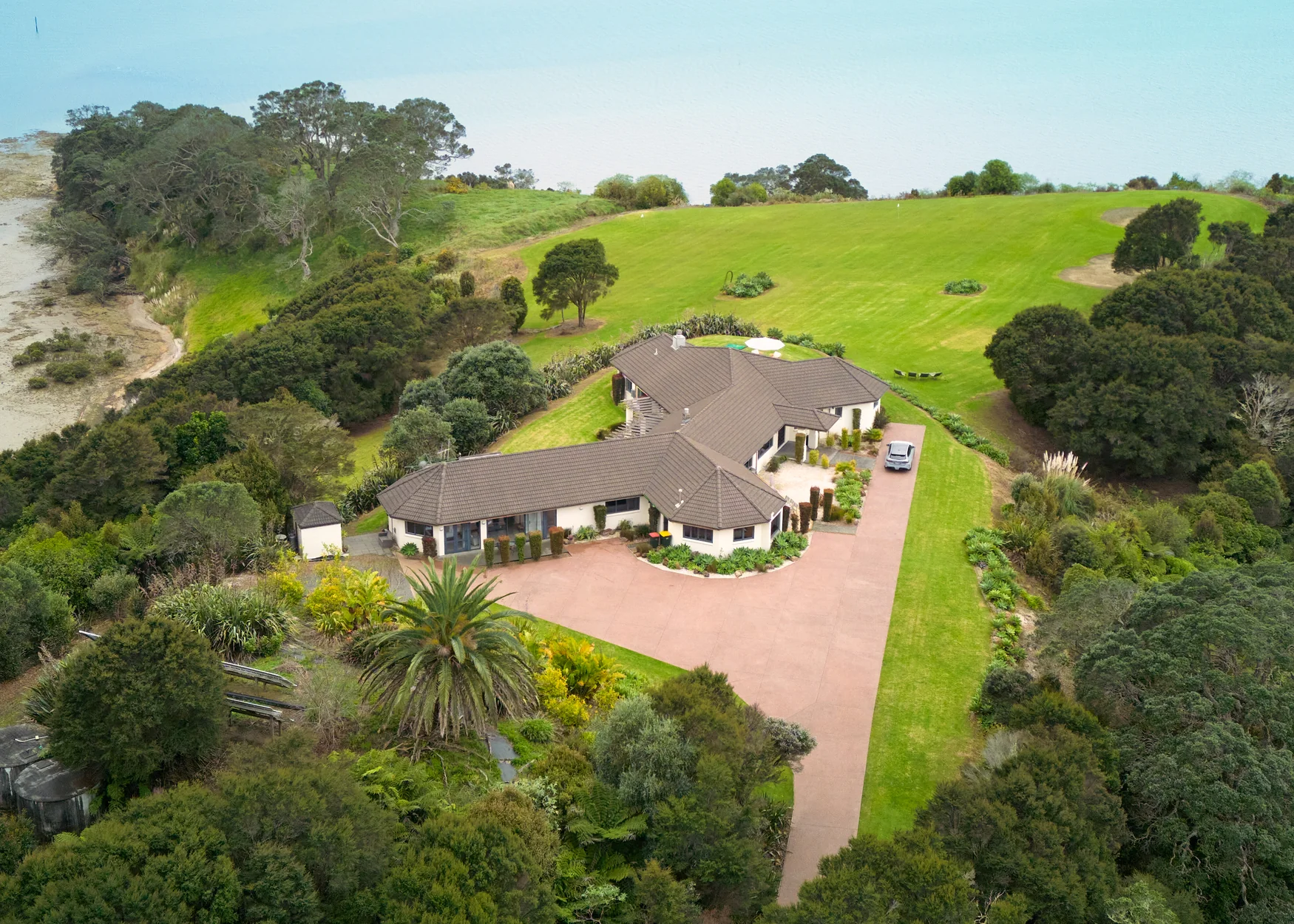
6 bed POA