The quiet ambition behind Van Cleef & Arpels’ latest Poetic Complications, according to the man who built them
by Hamish McDougall
Photography by Kevin Khng
At Van Cleef & Arpels, a watch is rarely a watch. Since 2006, the maison has pursued its Poetic Complications, a line that enlists mechanical watchmaking in the service of storytelling rather than sport or record-breaking. Watchmaking and Art Mechanics Development Director William Faura, who shepherds each creation from sketch to finished object, casts his role in musical terms. “Like the conductor of a watchmaking orchestra, we have designers, engineers, animators, craftsmen. We have to understand their limits, and what is possible.”
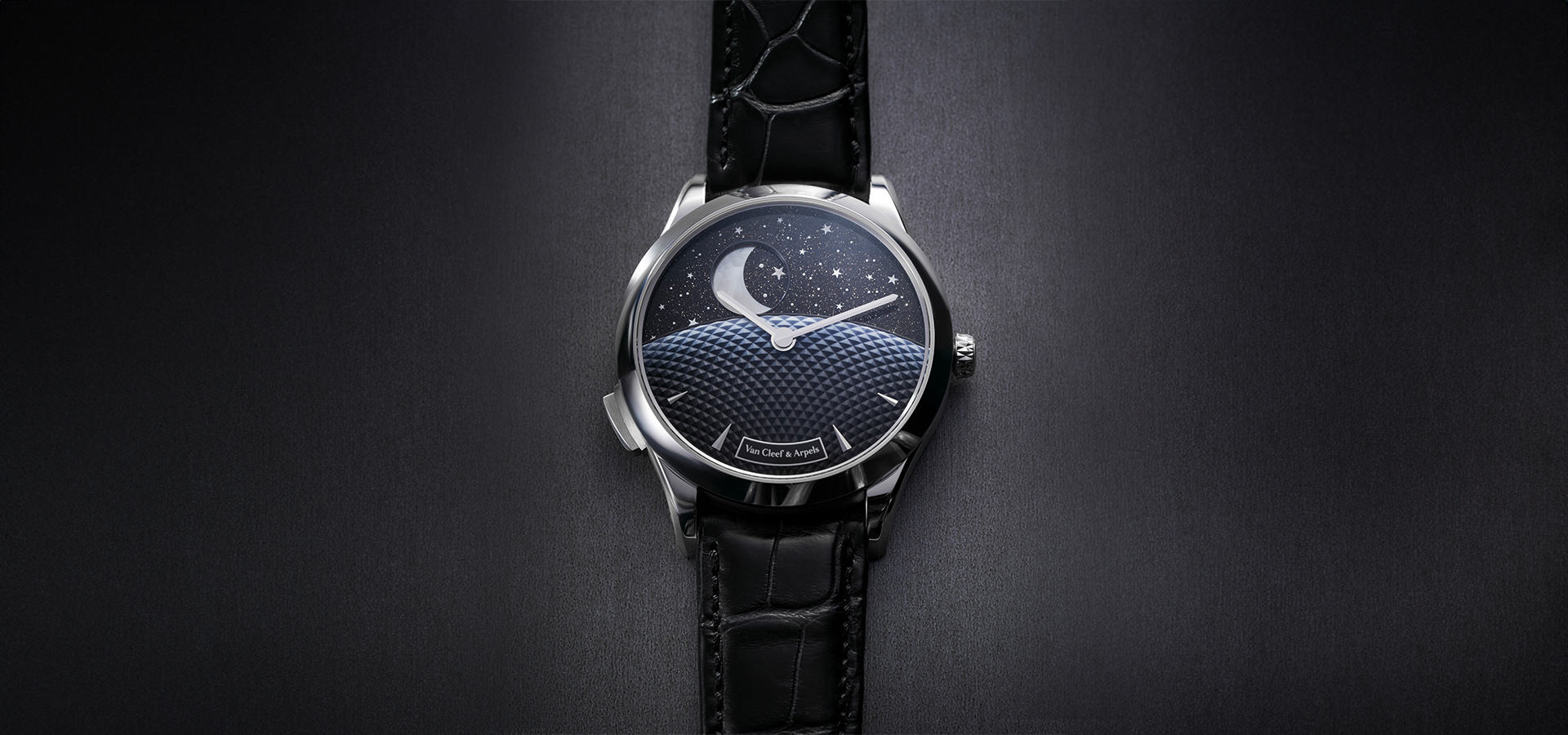
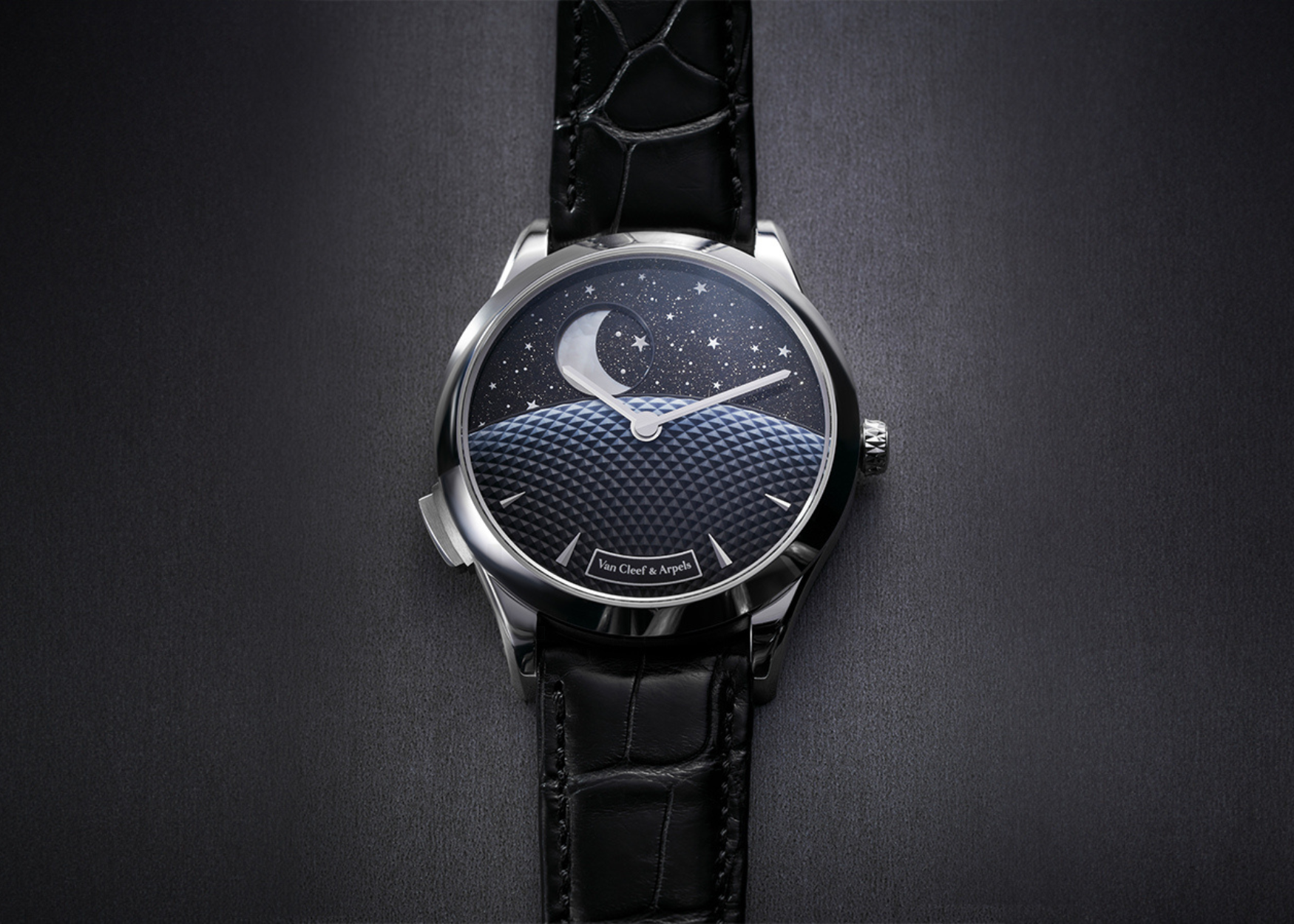
The year’s most intricate proposition is the Midnight Jour Nuit Phase de Lune (top), a day-and-night watch built on a dial of black aventurine glass. The Jour Nuit display has anchored the collection since its 2008 debut, and was revisited in 2024. A sun in guilloché gold turns once every 24 hours before yielding to the moon, which waxes and wanes. A second disc tracks that lunar month with quiet exactitude, completing its rotation every 24 hours, 16 minutes and 27 seconds—calibrated to the moon’s 29.5-day rhythm. Press the pusher and the dial animates to reveal the phase, even when the moon is below the horizon.
Aventurine glass is no ordinary material; it is born when mineral ore is fused into molten glass at around 1,200°C to produce that deep, star-flecked blue, the crucible then left a full month to cool before it can be broken open. The difficulty lies beneath the beauty. “The first disc has the sun and aventurine, but because the sun is gold, the disc is unbalanced. So we had to reimagine the plate inside to make it balanced.” Weight being the enemy of the 36-hour power reserve, that plate was machined from an aluminium lighter than titanium, and two differentials keep time honest: “If you play with it 20 times, it still has to recover the correct time and not lose ten seconds.”
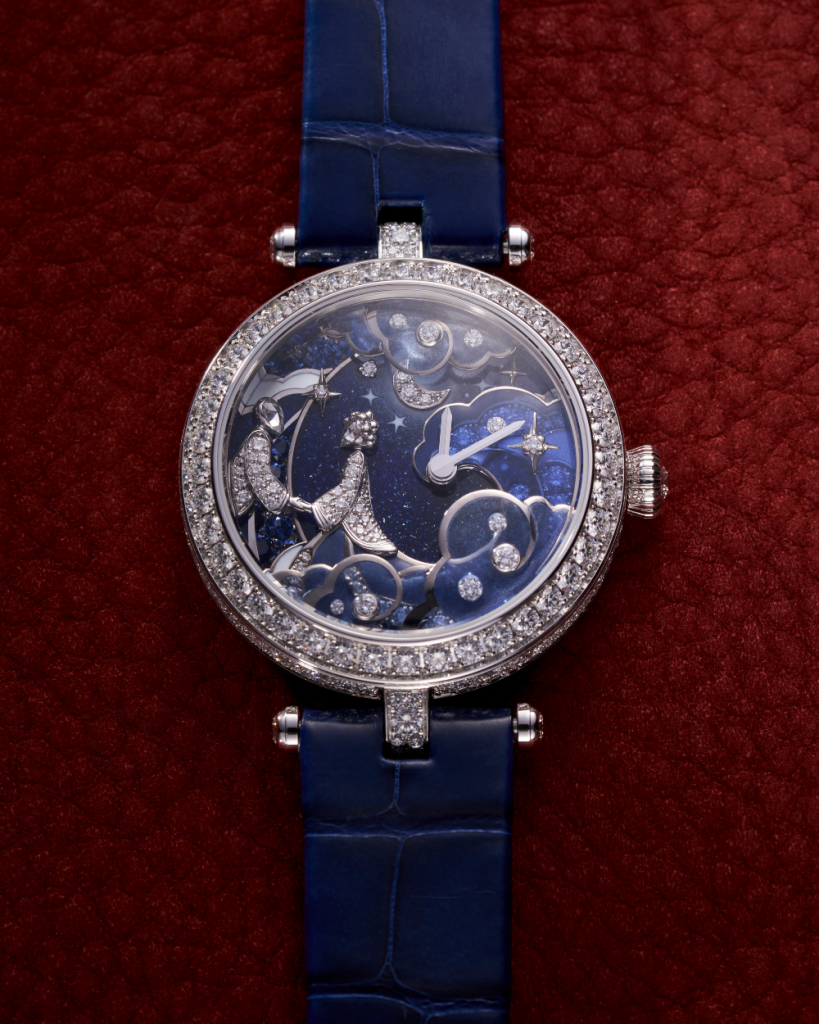
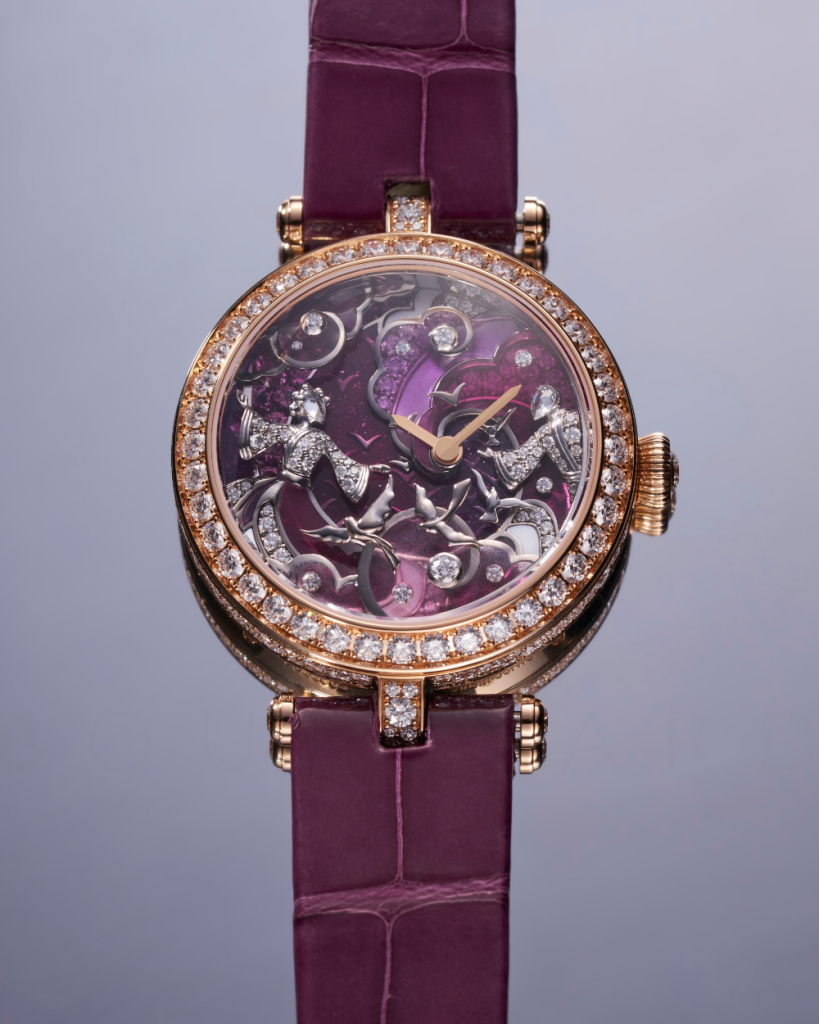
Van Cleef & Arpels’ Lady Rencontre Céleste and the Lady Retrouvailles Célestes.
Rarer still is a pair limited to eight pieces apiece, named the Lady Rencontre Céleste and the Lady Retrouvailles Célestes. They tell one of the oldest love stories in the sky: Vega and Altair—the weaver Zhinu and the cowherd Niulang of East Asian legend—lovers parted by the Milky Way and allowed to meet just once a year. Housed in 33mm cases, they marshal the full vocabulary of the Geneva workshop: champlevé and snow setting, grisaille and plique-à-jour enamel, through which light passes as through stained glass. A patented technique, the fruit of two years’ research, sets diamonds directly into the plique-à-jour with no surrounding metal; on each caseback, the Summer Triangle of Vega, Altair and Deneb is hand-engraved—more than 22 hours of work alone. “It’s a mechanical watch that is like a piece of art,” says Faura, “because you can look at many details that express the depth.”
Faura resists naming favourites—“all the developments are like our babies.” He confesses a fondness, though, for this year’s Jour Nuit. “It’s a watch that fits everybody, because it conforms to the wrist and the dial is alive.”
That dial is the achievement. It reads black in one light, warm amber, like cognac, in another—a dichroism the maison’s enamellists developed at its Meyrin atelier in Geneva, inspired by the way a ruby holds cool undertones within a warm colour. The enamel is laid over polished gold to amplify the play of light, worked for more than 30 hours at low temperature before firings above 1,000°C settle and clarify it, and holds a central motif and radiating guilloché in one layer. Beneath the simplicity sits real ambition: a dual-time-zone movement, Heure d’ici and Heure d’ailleurs, with double jumping hours, retrograde minutes and a 65-hour power reserve. “It’s a watch where you can see depth and feel emotion,” Faura says.
None of this is quick, nor at the outset always certain to be possible. The development of each watch runs in four stages, the first the most decisive: alignment with the creative studio on story and design. “We have many back-and-forth discussions about what we are able to do, what we are not able to do yet, what we might achieve in a few months—and what is impossible.” Only then does the work accelerate—a prototype, validation of every technical point, then the tooling to build it. The romance is the easy part to see. The years behind it are not.
Go further with the 2026 edition of Watches and Wonders in Geneva.
Read next:
8+1 bed | 10,200 sqft area 19,500,000 SGD
5 bed 19,380,000 SGD
4 bed | 4,208 sqft area POA

3-8 bed | 699,654 - 784,080 sqft area POA
6 bed POA