The interview: Artelier’s David Knowles explores the art consultant’s evolving role in luxury hospitality and beyond
by Mac Fabella
David Knowles has carved an interesting path in the arts. He is the founder and creative director of UK-headquartered art consultancy and advisory firm Artelier, which has earned international success and renown by essentially being, as he puts it, “the Tinder of the art world”.
“Our database of artists has around 20,000 artists on it, and we have about the same amount of clients and contacts on our database as well,” Knowles tells Boulevard. “So I like the idea that, for every client, there’s an artist. And we’re just making those connections.”
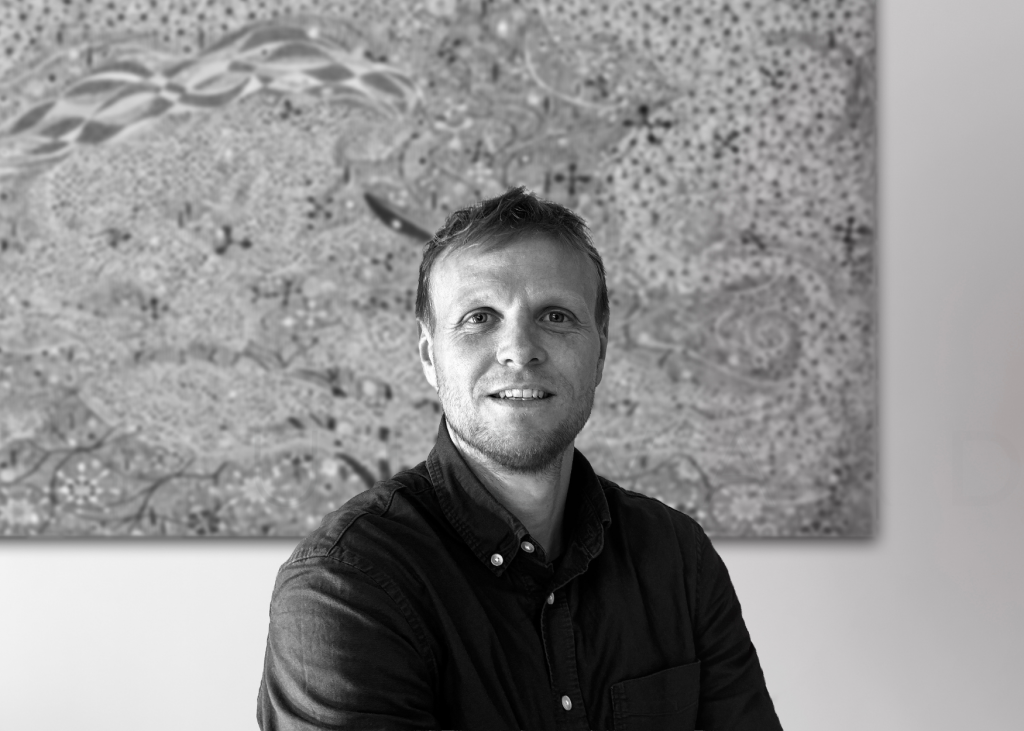
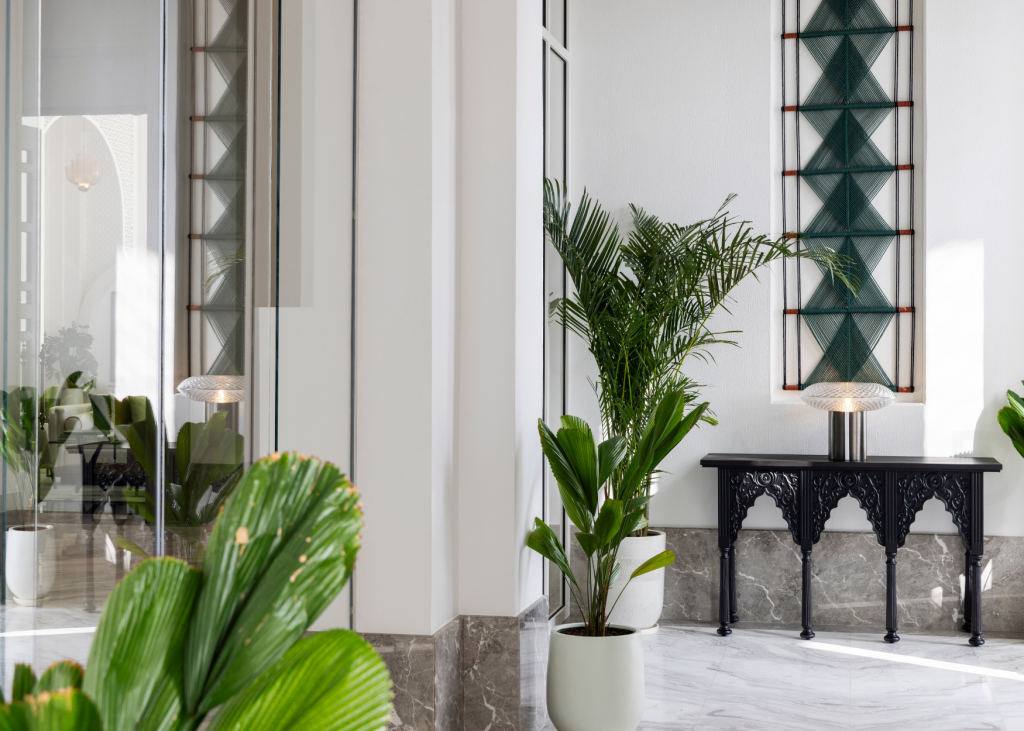
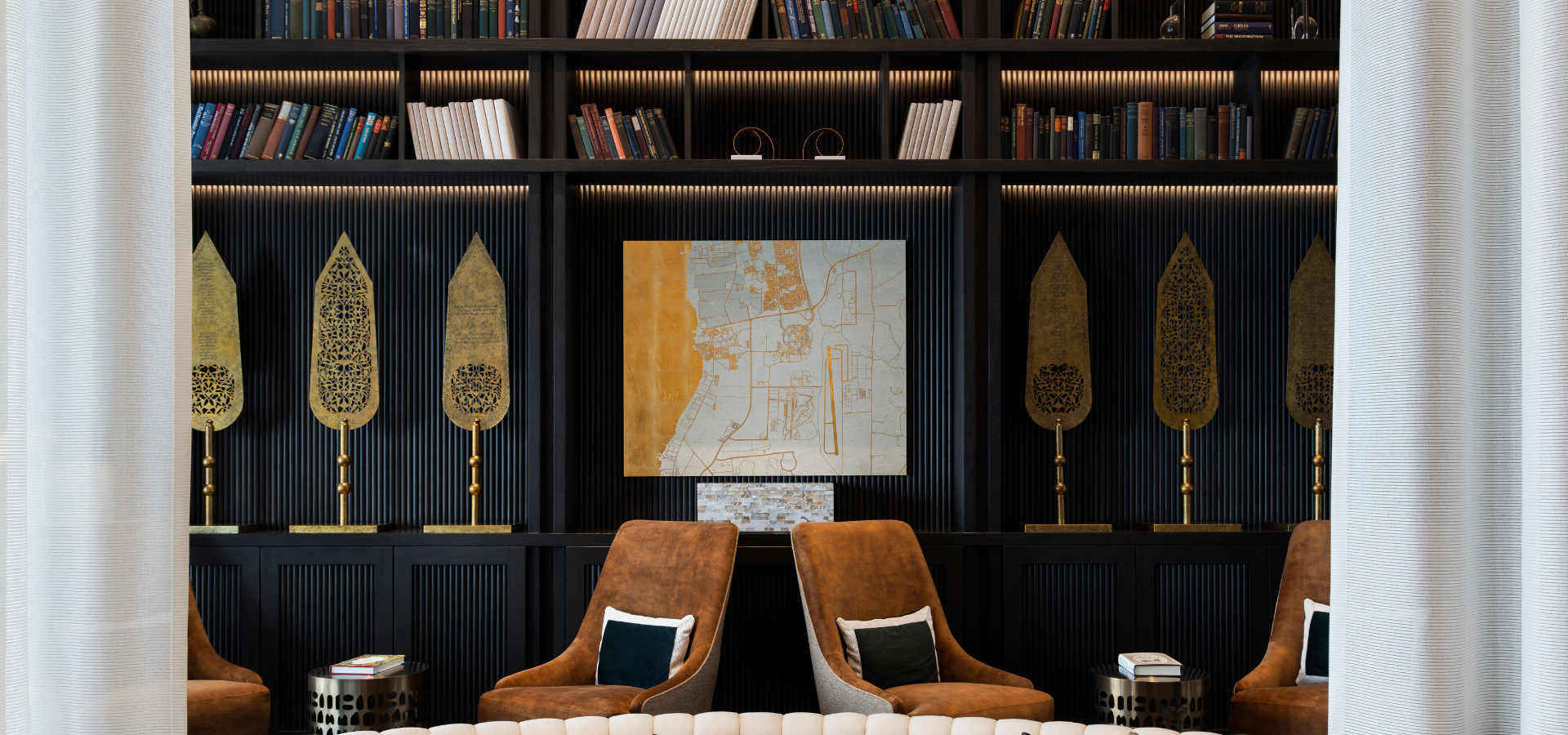
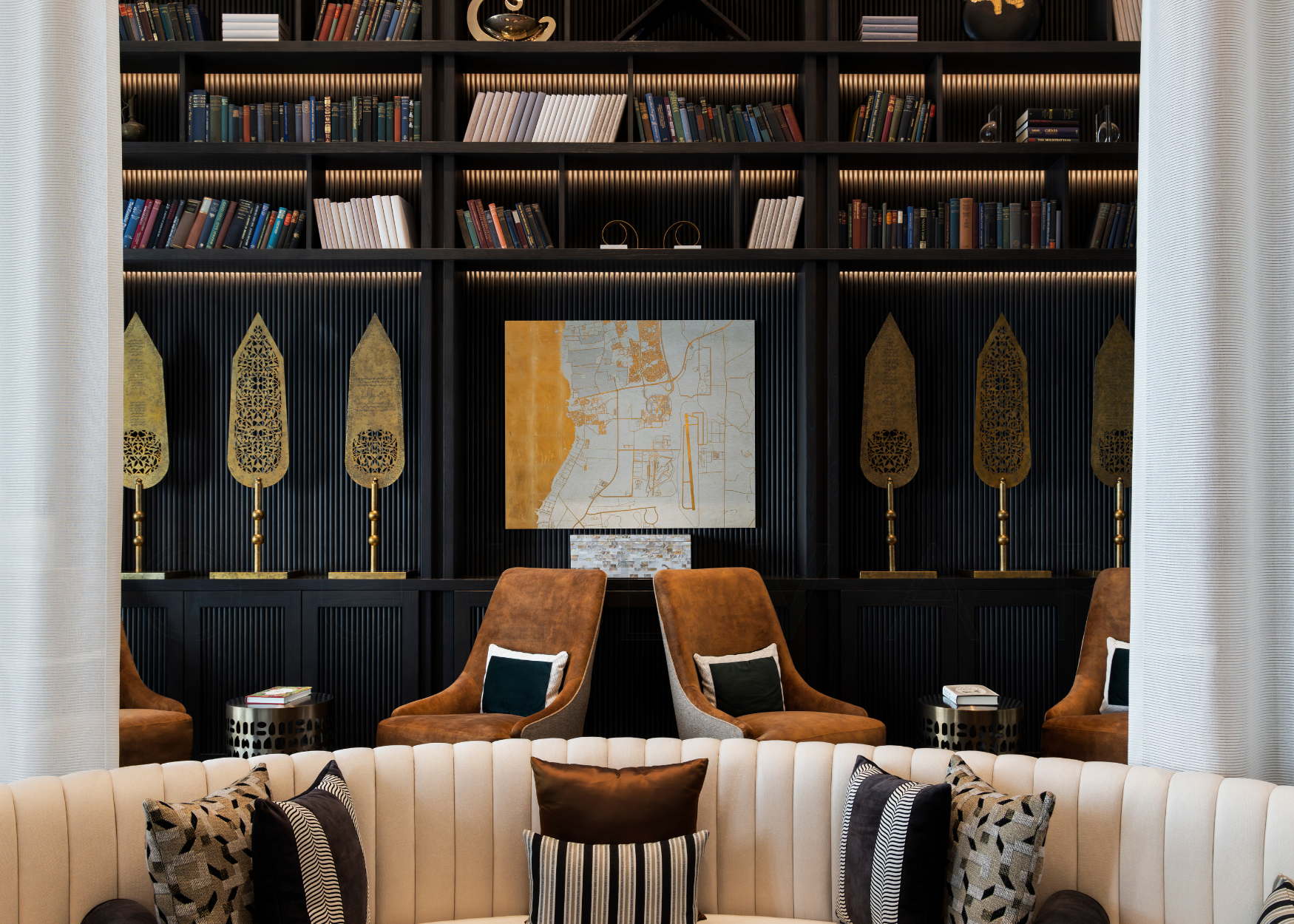
Left: Artelier founder and creative director David Knowles. (Photos courtesy of Artelier) Right: A piece by Las Vegas-based fiber artist Alisha Ing, who goes by moniker I Would Rather Knot, hangs in the halls of Raffles Al Areen Palace, Bahrain. Top: The Writer’s Lounge in the same hotel. (Photography by Tooze Studio)
Artelier today has offices in Barcelona, Dubai and Hong Kong; and clients, projects and artist-contacts all over the world. Specialising in bespoke contemporary works, they leverage this global network to source and deliver timeless, unique and investment-grade collections wherever they may be desired: from private residences, yachts and aircraft to luxury hotels, public art spaces, exhibitions and corporate offices.
Knowles—who holds a Masters in Fine Art and is trained in art research, production and critique—established the firm in 2012 when art consultancy was a little-known specialism. Since then, he has seen the demand for it grow as it increasingly enters the conversations once kept between clients and interior designers. Such is the case especially in the most “ambitious” projects, like a hotel where guests are perpetually coming and going.
Artelier has worked with big names in hospitality—Aman, Rosewood, Four Seasons, Six Senses, The Ritz-Carlton and Marina Bay Sands among them. In this conversation with Boulevard, he talks about how each property poses a unique challenge and gives a glimpse into their process of translating brand identity into curated collections that will outlive any trend.
Boulevard: How has the demand for art advisors or curators like yourself evolved, especially in relation to luxury hospitality?
David Knowles: When I set up Artelier about 15 years ago, art consultancy was a known industry but still quite a new concept for a lot of people. A lot of clients and people running projects weren’t aware that art consultancy was its own specialism or this field in itself. They would rely a lot on galleries or dealers, but those would usually have their roster of artists that they’re committed to selling first and foremost.
In the purest sense, to be an art consultant, you have to be completely impartial in terms of your relationships with artists and who you’re trying to sell to a client. You’ve got to really listen to the client and follow them regardless of how much money you can make out of the project.
For private projects—residences, holiday homes, yachts, aircraft—people are always looking to push the design and interiors. That’s where they get top interior designers coming in to do interesting things. The best projects are the ones where they identify that they need a proper art consultant and carve that off as a separate expertise.
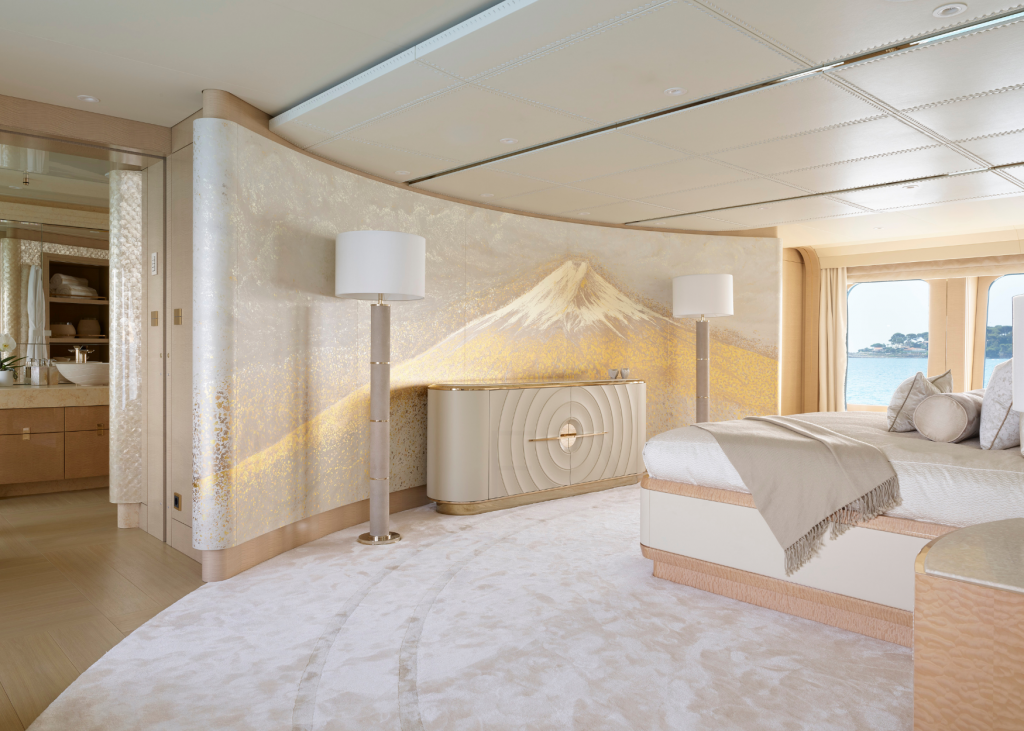
Artelier curated and commissioned artworks for the yacht Neninka (ex. Aurora Borealis, 67.6m), including delivering custom murals, paintings, sculptures and decorative vases. (Photography by Winch Media)
Sometimes people try to do it themselves or get the design firm to do it, and it doesn’t usually work very well unless someone involved has training and a keen eye. Sometimes clients have a real passion for art and enough contacts and knowledge to do it themselves, but generally the need for the art consultant comes when people have ambitious projects, whether it’s a home or a hotel where you have lots of guests coming and staying.
Blvd: At what point in a project should the art conversation begin?
Knowles: Ideally, it would start at the very beginning of a project. Sometimes projects are designed around an artwork. It could be a hotel with an outdoor land art installation where the hotel is shaped around it. Or there could be a key artwork in an interior that acts as a central anchor for the entire design.
So ideally, early on. But having said that, if we’re brought in too early, there can be too many unknowns and possibilities, and it can become time-consuming exploring every direction.
It’s also okay to come in later on, as long as it’s not too late and we still have enough time to commission bespoke pieces. Sometimes it’s quite nice to be handed a completed space and told, “Here are all the spaces, we’ve left nice blank walls for you, now go and do your thing.” That gives us something tangible to really work with.
There’s no right or wrong way of doing it, but if we’re brought in later, we still need enough time. A consultancy process might need six months, and commissioning or sourcing decent pieces could take up to a year.
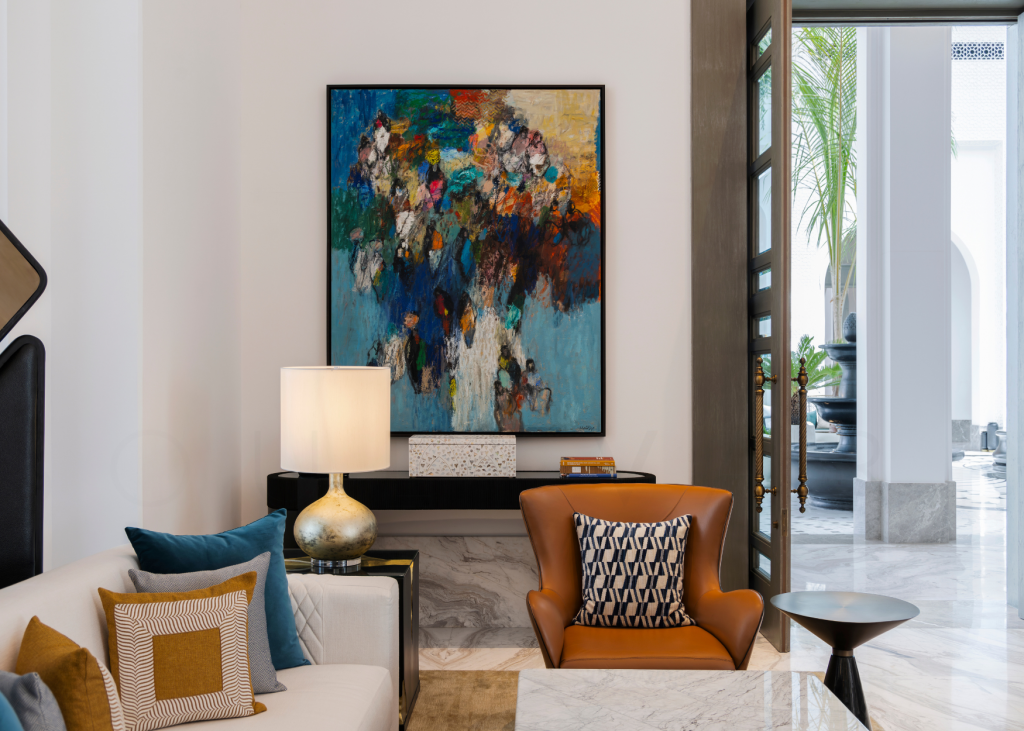
Several artworks, like this piece by Bahraini artist Omar Al Rashid, are purposefully chosen to stand out in the space. (Photography by Tooze Studio)
Blvd: Do you find yourself working closely with interior designers from the beginning of projects?
Knowles: Certainly, in the early days, we worked a lot with interior designers. We still do, but usually we’re hired directly by the client, so our direct reporting is to them.
We collaborate with the interior designer to a certain extent, and it’s always good to get their input in terms of whether the artwork integrates well with the interiors. But the natural tendency of interior designers is often to tune things so they all look complimentary.
Sometimes we have to resist that and say, “No, actually we want this artwork to have more of a punch in the space. We don’t want it to blend in. We don’t want it to look like décor.” Sometimes we purposely want the colours to clash a little bit. The fabrics on the sofa or cushions might be replaced in five or ten years, but if this artwork is a high-value collector’s piece, we shouldn’t compromise the quality of the artwork for the interior.
Artists also need to be given their space. If you push them too much in one direction, the artwork falls apart. You have to have faith in the artists and what they do.
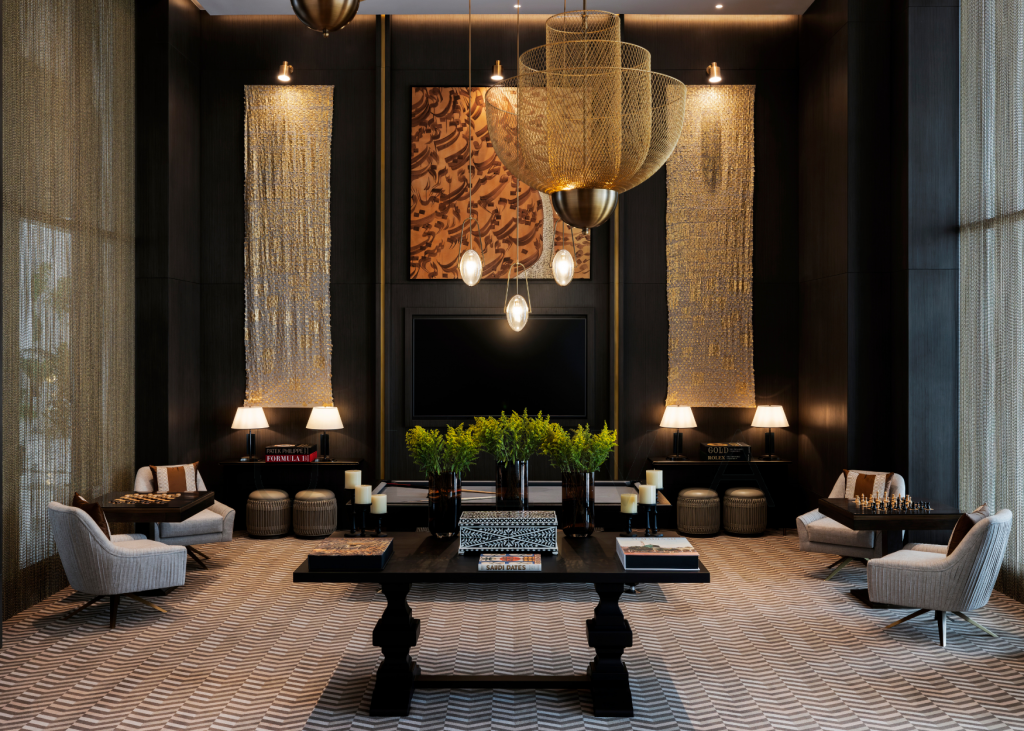
Artelier lended their comprehensive art services and expertise to Raffles Al Areen Palace, Bahrain. (Photography by Tooze Studio)
Blvd: Once you’re on board a project, what’s the first thing you look for when developing a direction for the art?
Knowles: We need to know the nuts and bolts of the project. Where are the opportunities for art? Some may already be identified, but we may also need to do some studies and think outside the box. Art might mean permanent works on walls or plinths, but some projects also involve programming. Some hotels, for example, have rotating exhibitions or temporary collaborations with curators and galleries. So we’re not always looking at a static collection.
We need to know the property, the spaces, the timelines and the budget. We don’t want to present artworks that are completely out of reach financially because that’s just frustrating. We only want to put forward viable options.
Then we need to understand the client and the project. If it’s a hotel, what are the brand principles? If it’s a private client, what are their interests? What kind of art have they bought before?
We have amazing contacts and artists around the world, and we always like to bring a new flavour to each project. We don’t have a template where we roll out the same thing over and over again. We love it when we get a quirky client from a country we haven’t worked with before because we can explore local artists and do something quite different.
Blvd: Hospitality brands often have a strong identity and narrative. How do you ensure that translates into art?
Knowles: We study their brand principles. Usually they have documentation or presentations around that. We visit their hotels firsthand and immerse ourselves in the experience—not necessarily staying as guests, but walking around and getting a feel for the atmosphere.
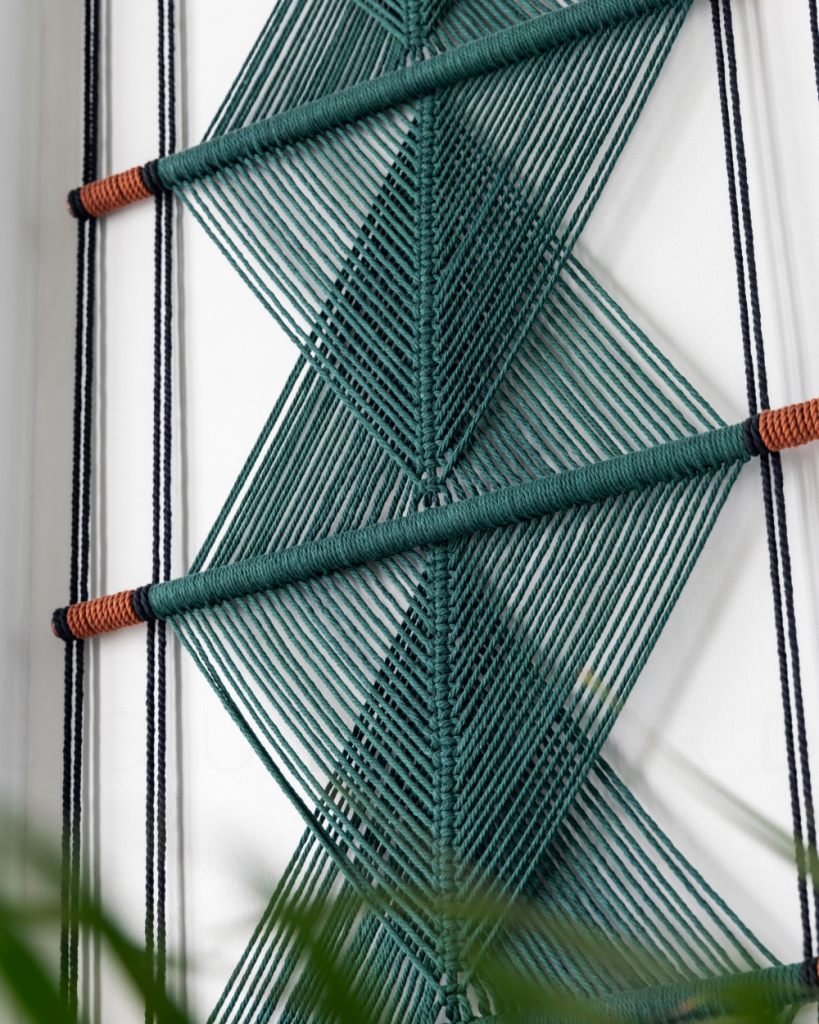

Details on some of the artworks displayed at Raffles Al Areen Palace Bahrain. (Photography by Tooze Studio)
We try to work out what makes that hotel brand unique because many hotel brands say very similar things. We have to get to the nub of it. Often it’s about celebrating the locality, the building or the heritage. We create almost a matrix or a series of filters and parameters, and the art has to fit through it.
For example, if it’s a project in Jordan, can we involve Jordanian artists? Is the project in the desert? Is there a nearby heritage site? We identify the unique factors and then curate artwork that feels meaningful and relevant.
Blvd: Could you name a hospitality project that challenged you the most?
Knowles: Every project has challenges. Sometimes hotel brands reinvent themselves while you’re in the middle of the project—they change teams, evolve their philosophy, and everything becomes a moving target. That means work sometimes has to be redone.
But in terms of a positive challenge, I’d say The St. Regis in Venice. We’re turning hotel art on its head there. Instead of commissioning or purchasing works for the hotel, it’s an exhibition model tied to the Venice Biennale. We launched a curator competition where curators from around the world proposed exhibition concepts. We shortlisted them and mounted the exhibition.
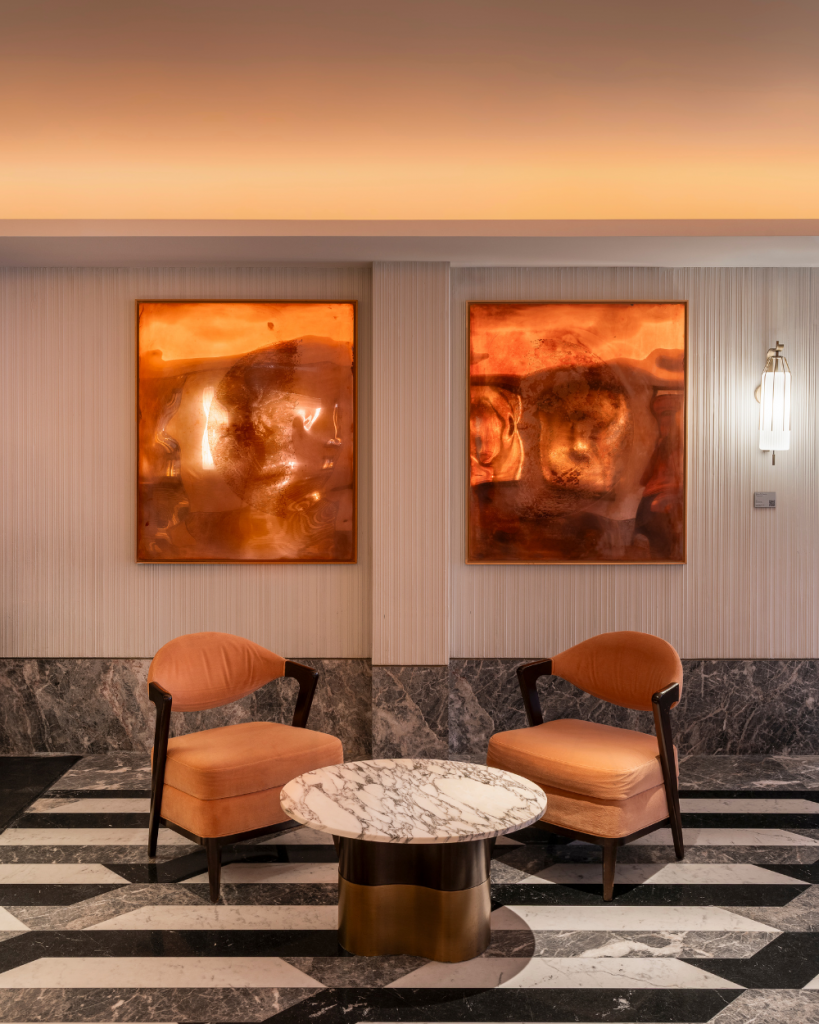
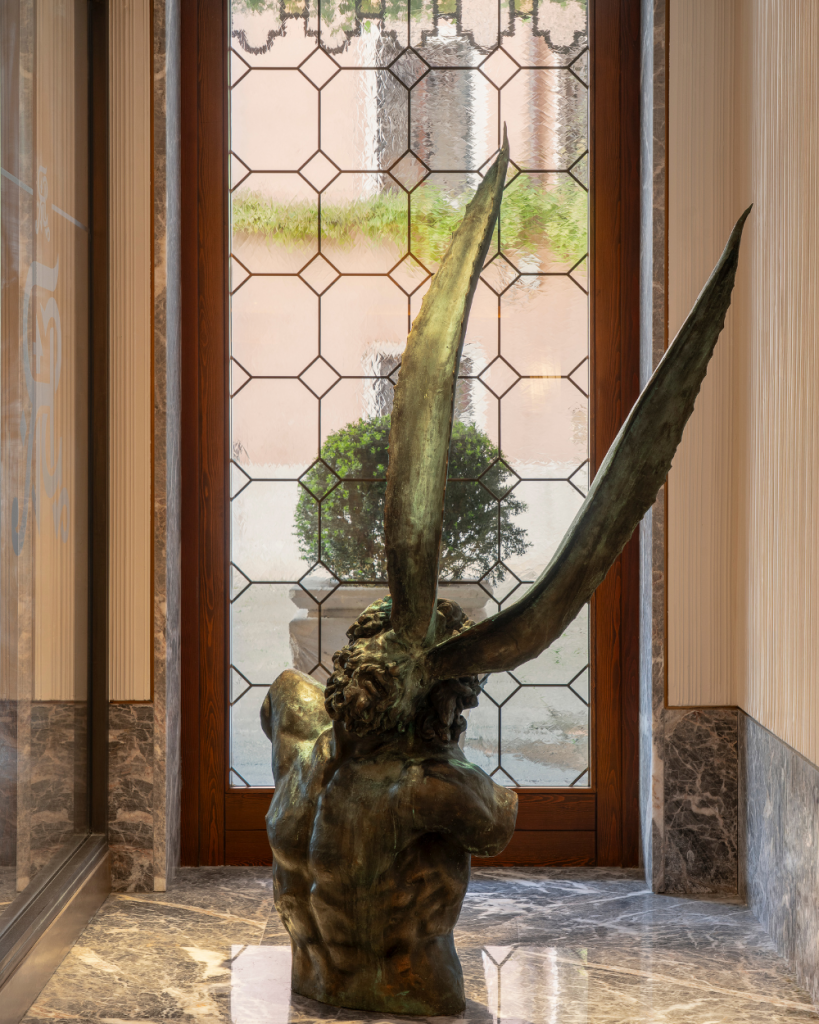
Some of the art by Marco De Sanctis displayed at The St. Regis in Venice, including ‘Crepuscolo’ (left), engraving on copper, and ‘La Pleureuse (Laocoonte)’ (right), a bronze sculpture with copper patina. (Photography by Tiziano Ercoli)
That project is challenging because we’re working within a heritage palazzo in Venice. Logistically, Venice is difficult because of the canals and transport. You need specialist local knowledge. You also can’t damage the building, so you have to be extremely sensitive to the heritage environment. But those are positive challenges. Dealing with challenges is my job, and it’s fun.
One of our main challenges is the international nature of our work—maintaining good communication with clients and delivering quality consistently. But that’s our expertise. It’s all based on collaboration and having a trusted network around the world.
Blvd: You recently opened a client office in Hong Kong. Could you tell us a little about that decision?
Knowles: Hong Kong is a real hub in the Asia region. Artistically, it has a huge concentration of galleries, and it’s a major commercial centre as well. We already have a client office in Dubai, and Hong Kong is a strategic location because we have projects in the region. It’s a strong focal point for servicing clients there.
The time zone difference is also important. There’s only a small overlap between European and Asian working hours, so having team members there who can handle day-to-day matters and scout new business is really valuable.
Blvd: How do you see guests engaging with art, and what kind of emotional response are you hoping to create?
Knowles: With hotels, it’s interesting because it’s now very much “the thing” to have art and create an experience around it. I’m all for that, but there’s also a slight element of skepticism because sometimes people just want to go to a hotel and have a lovely time and immerse themselves in the ambience.
The experience has to relate to the brand. For Aman, for example, it’s more restrained luxury—minimal, earthy, restorative, meditative, slightly spiritual. The art shouldn’t be overly stimulating. Then if you look at St. Regis Venice, it’s about stimulation. You’re immersing yourself in Venice and the Biennale. It needs to be thought-provoking, challenging, edgy.
Other brands may just want elegant materials and classic luxury. So if we’re talking about hotels, we need to deliver that brand experience while still gently pushing boundaries.
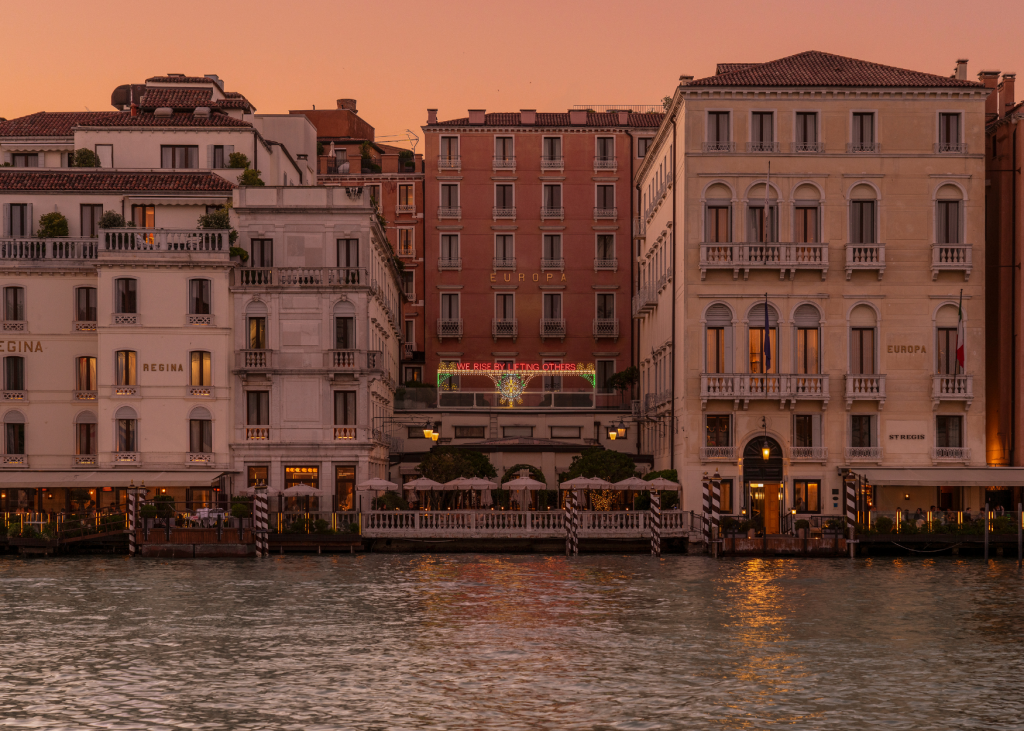
Gracing the facade of The St. Regis in Venice is “We Rise by Lifting Others”, a neon sculpture by Marinella Senatore. (Photography by Tiziano Ercoli)
Personally, I think it’s about understanding art in context. Some works are more decorative or craft-based, and contemporary craft is absolutely an art form in itself—especially in places like Japan, where it’s highly revered. Other people may say, “That’s not real art.” They might say what we’re doing at St. Regis Venice is “real art” because it’s contemporary, conceptual, gallery-based work.
But for us, it’s all about context. There’s a time and place for all kinds of art and artists. We’re not snobbish in that sense.
What we hopefully do well is recognise talent and respect the work for what it is, placing it in the right context where it can be fully appreciated. What we don’t do is generic Pinterest-style art or catalogue art. We stay true to originality. We don’t follow trends or regurgitate ideas from other people’s projects. There’s plenty of originality out there—people are often just too lazy to go looking for it.
Blvd: What are you still learning in the space of art curation? And what still surprises you about how people look at art?
Knowles: The biggest thing we’re learning is through international collaboration. Every week or month we’re connecting with different clients or teams in countries or regions we may never have worked in before. So we’re constantly learning about culture, history, civilizations and heritage.
Art is an incredible communicator of that. It celebrates heritage and culture, whether historical or contemporary. We’re always meeting new people and learning more about the world around us.
There are people who would turn down work in certain regions for social or political reasons, but I think it’s dangerous when people assume a moral high ground in that way. We’re always open to learning more about these places around the world. That’s what keeps us going.
Blvd: Is there anything else that you’d like to share about the work you do outside of hotels?
Knowles: We’re also constantly working on yachts. We usually have a small cluster of yacht projects underway with ultra-high-net-worth private clients. Sometimes airplane projects come from that circle too.
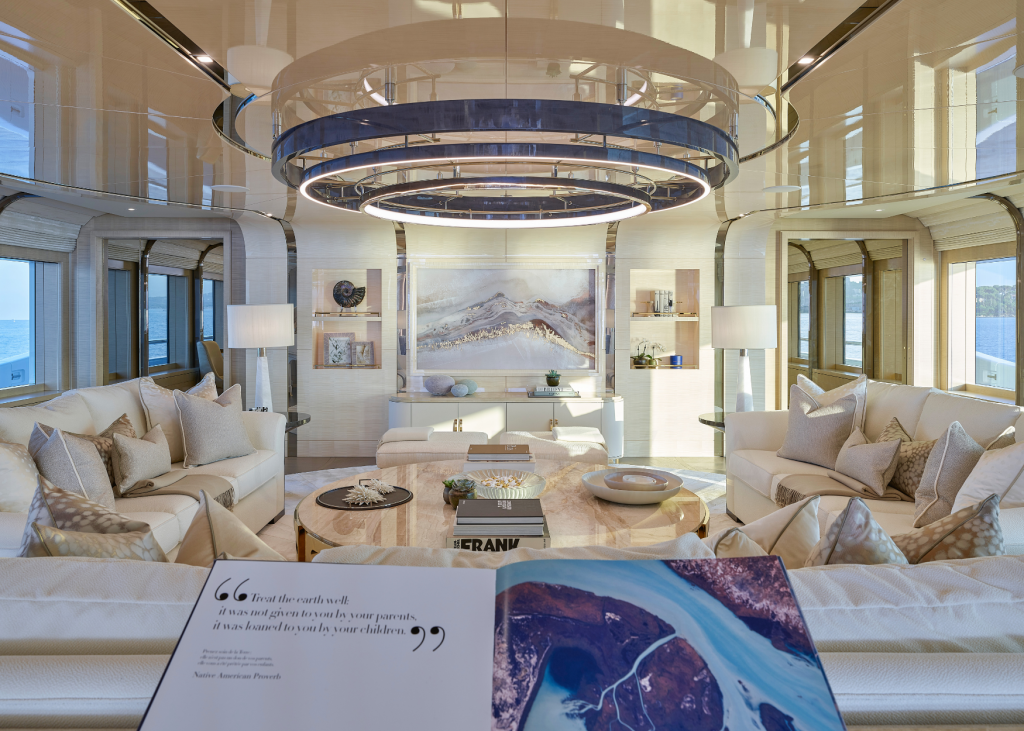
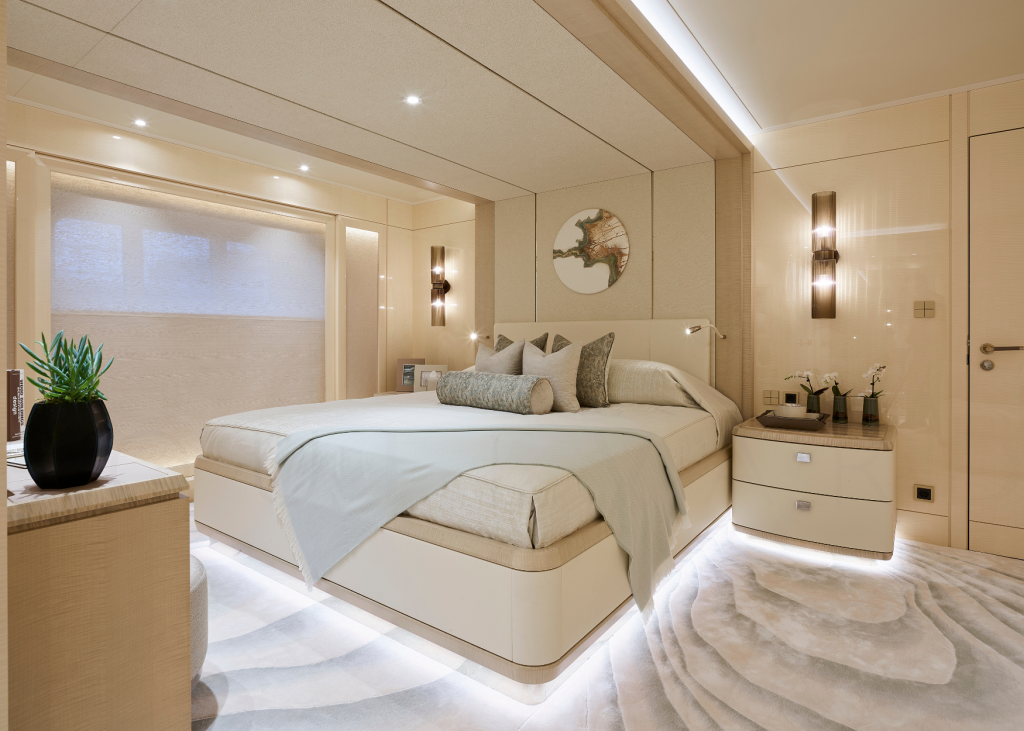
When owners want to sell and charter their yachts, a bespoke artwork collection proves an asset to the owners. (Photography by Winch Media)
One thing we haven’t spoken much about is public art. We work on public art projects, mostly in the UK. When developers build or redevelop major buildings, there are planning rules that often require them to contribute something back to the community through public realm initiatives or public art. That process is interesting because it’s usually focused on one artwork, so all our energy goes into that single piece. We consult with the community, collaborate with architects, run artist competitions, shortlist proposals, and manage the entire process.
Because it’s public art, the work is subject to huge scrutiny. Everyone sees it, photographs it, comments on it. You have to think about all the different interpretations that might emerge. But you also don’t want to design by committee because then the work becomes watered down and boring. It’s important to stay brave and bold.
That’s the thing about us: we’re not a one-trick pony. We work across a huge variety of projects, but the same mentality applies throughout.
Sometimes we approach projects from too intellectual or academic a perspective for certain hotels. Some just want a quick one-size-fits-all solution. But we like to take a few steps back and really think about what’s meaningful and relevant, rather than just wasting people’s money. We’ve got to really believe in the pieces.
Read next:
8+1 bed | 10,200 sqft area 19,500,000 SGD
5 bed 19,380,000 SGD
4 bed | 4,208 sqft area POA
3-8 bed | 699,654 - 784,080 sqft area POA
6 bed POA