The interview: Jean-Loup Glénat, Franck Muller’s Head of Design, on the brand’s latest novelties and why his job is all about creating emotion
Interview by Hamish McDougall
Photography by Kevin Khng
In the world of high watchmaking, it’s remarkably easy to get bogged down in the numbers. Franck Muller has always operated on a slightly different wavelength. Known as the “Master of Complications”, the Genevan maison didn’t build its reputation just by making complex gear trains, but by making them inherently theatrical.
Enter, architect-turned-watch-designer Jean-Loup Glénat. As head of design, he’s the man tasked with steering the brand’s expressive, often provocative visual identity. At Watches & Wonders 2026, Glénat shared that, yes, a watch needs to be technically flawless, but it also needs to make you feel something.
“I would like to evoke the same passion from the beginning—that we have during the design process—in the lover or the buyer of the watch at the end.”
The industry is currently at a crossroads, with many brands playing it safe by re-releasing archival pieces against a backdrop of global uncertainty. Franck Muller, however, seems entirely uninterested in playing it safe—pushing concept and expression and feeling as much as ever.
The design process and Franck Muller’s highlights for the year
Jean-Loup Glénat: The design journey is divided between different states. We take time to imagine, to let our minds be free. But also we must be realistic about what we can and cannot achieve.
This is what I like about the journey. Part of the character of the designer is to be sensitive, but also be a realist and strong—strong because, when you have an idea, you are often alone with it in the beginning. You are alone in front of the page. We have to keep all the sensation around us, so that it gets translated in the material later on. We have to be strong so as not to lose those first ideas, the first feeling.
Sometimes we try to start from a blank page, but it’s never the same story. What we always have in mind is the legacy. We have only been here about 35 years, and we have many things to evolve in our existing collection.
This year we have a great, full collection. We’re arriving with a totally new shape and a new collection. We also pushed our limits with the complications and also a new, smaller shape for men. For ladies, we tried to have a lot of possibilities in different segments; some more spectacular, some more focused on aesthetics.
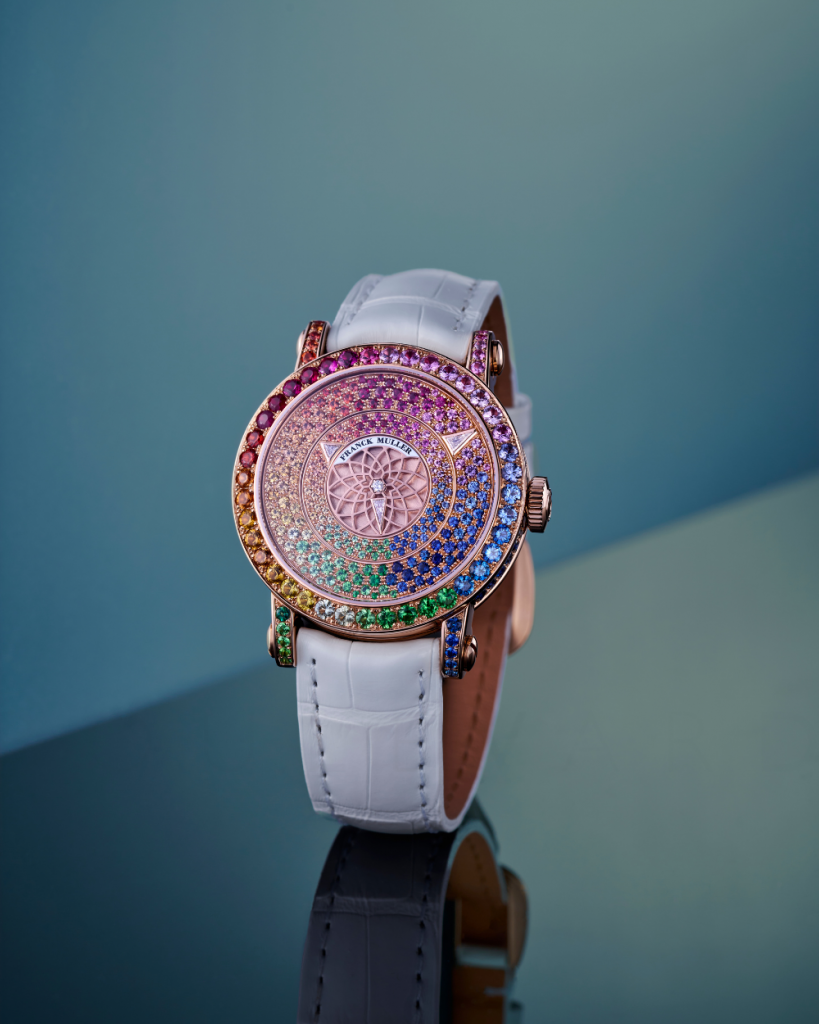
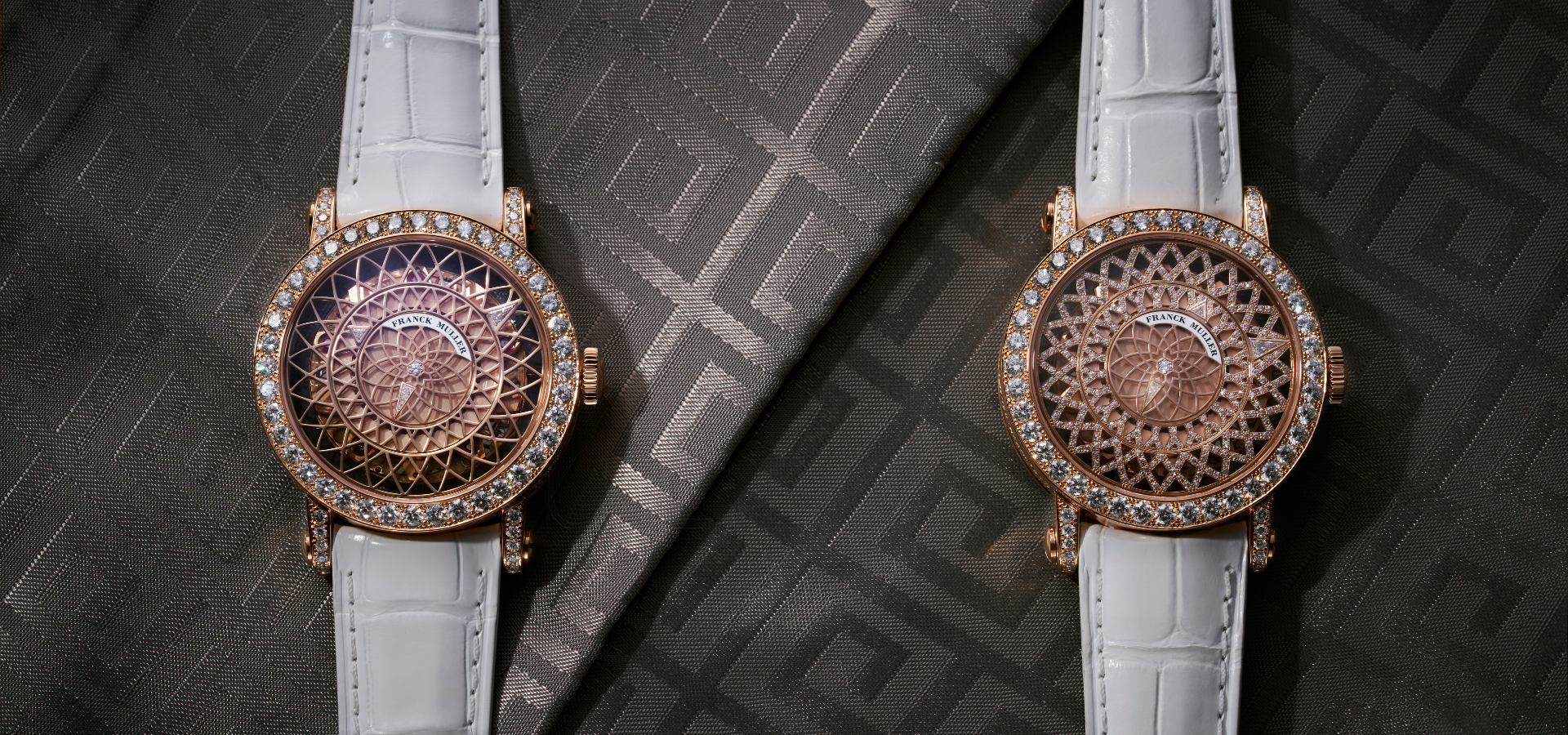
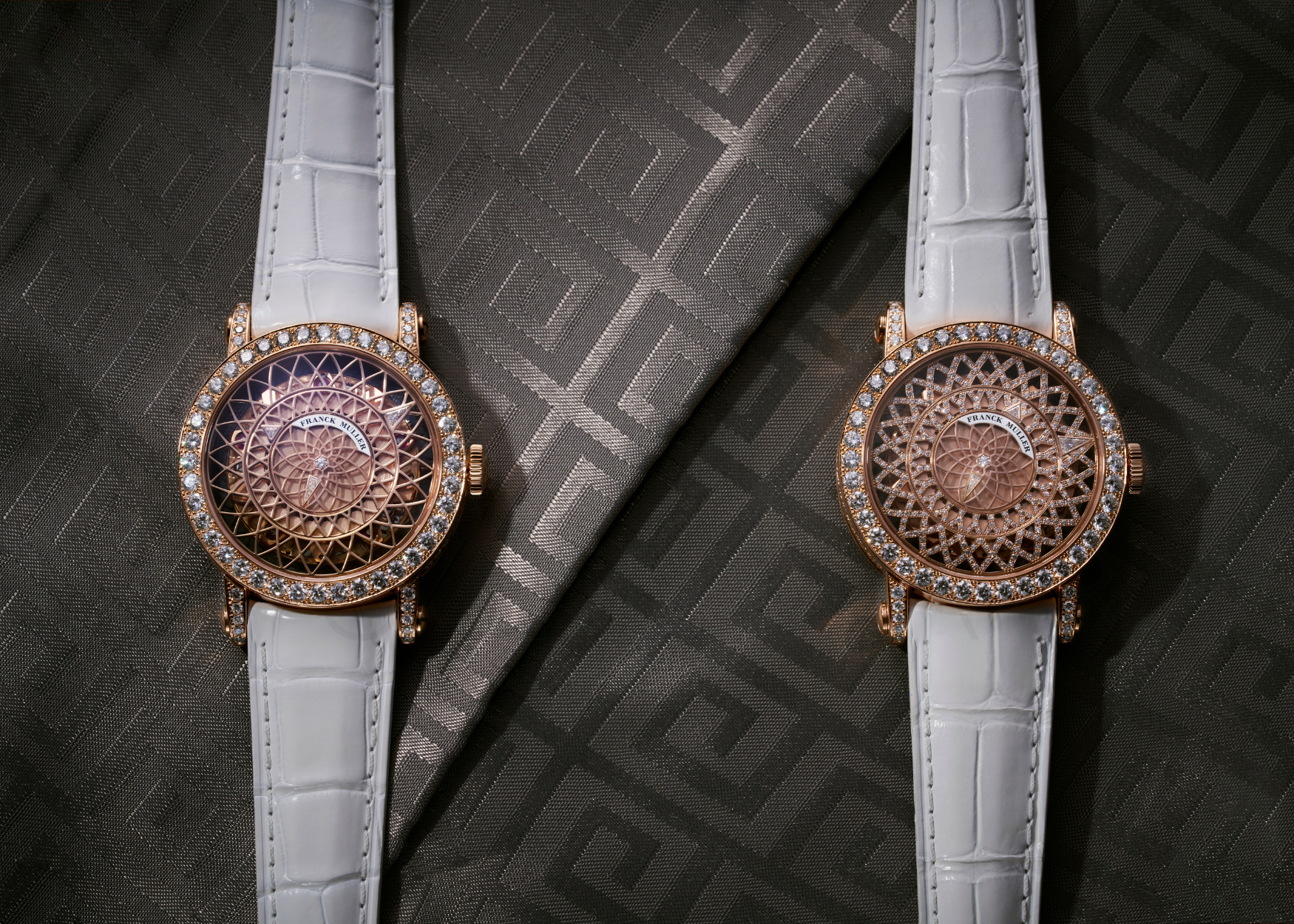
The Round Triple Mystery Rainbow (left) is defined by its gradient of gemstones, while the Round Triple Mystery Skeleton (right) reveals its movement through an openworked design. (Photos courtesy of Franck Muller) Top: Round Triple Mystery Skeleton, photographed by Kevin Khng at Watches and Wonders 2026.
The mechanical theatre of the Triple Mystery and the Master Jumper
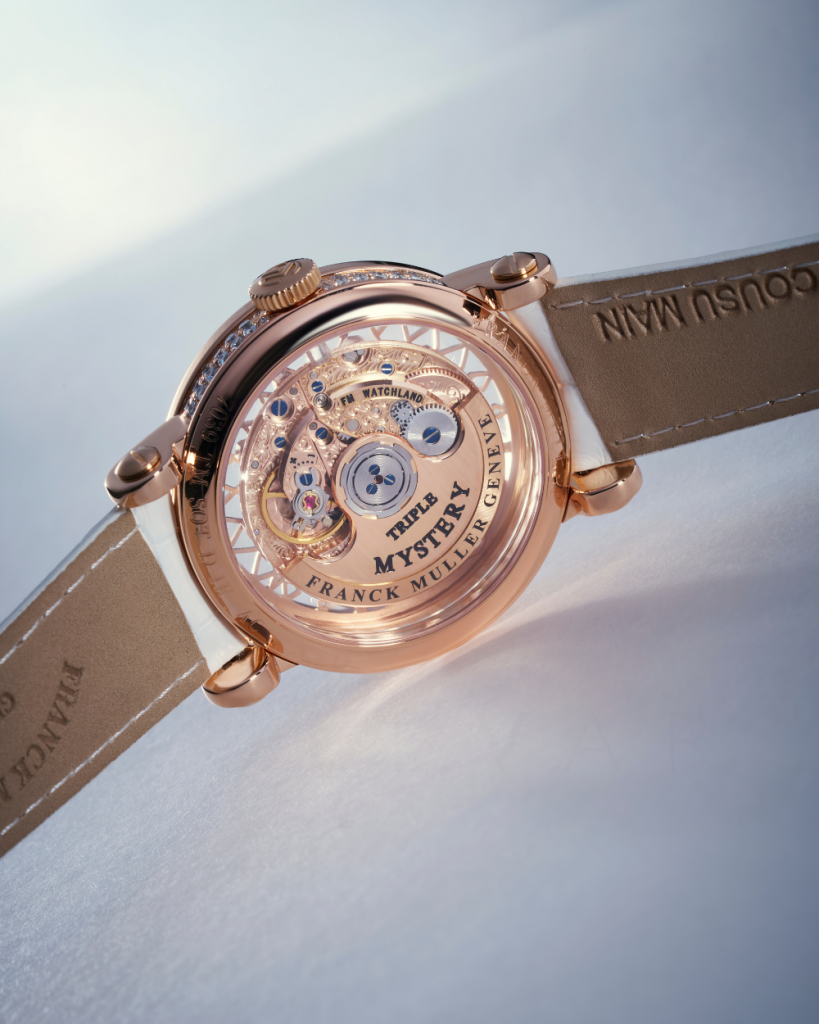
Glénat: Franck Muller created, many years ago, the Mystery, then the Double Mystery, and now we’ve presented the Triple Mystery. The idea was to have a full rotating dial with the hour, the minutes around the middle, and the seconds in the centre.
It’s a stunning piece with a rainbow setting, and because there are three rotations, there are different rainbow combinations. In the Round Triple Mystery Rainbow baguette version, the “real” rainbow comes only twice a day, at 10:10. From the graphic idea of the seconds in the centre, we decided to explore how we could make this effect. It’s really a game between the transparency of the discs and the mechanism behind. We tried to make a skeleton version for ladies, and here we use sapphire rings around the display.
Franck Muller also created the first triple-axis tourbillon many years ago. In the new Vanguard Aero
Revolution 3 Skeleton, we’ve kept the three-axis tourbillon cage but changed the construction of the movement. We wanted to put the tourbillon on top, and the barrels and other elements on the bottom, to create a lot of lift and place the tourbillon higher.
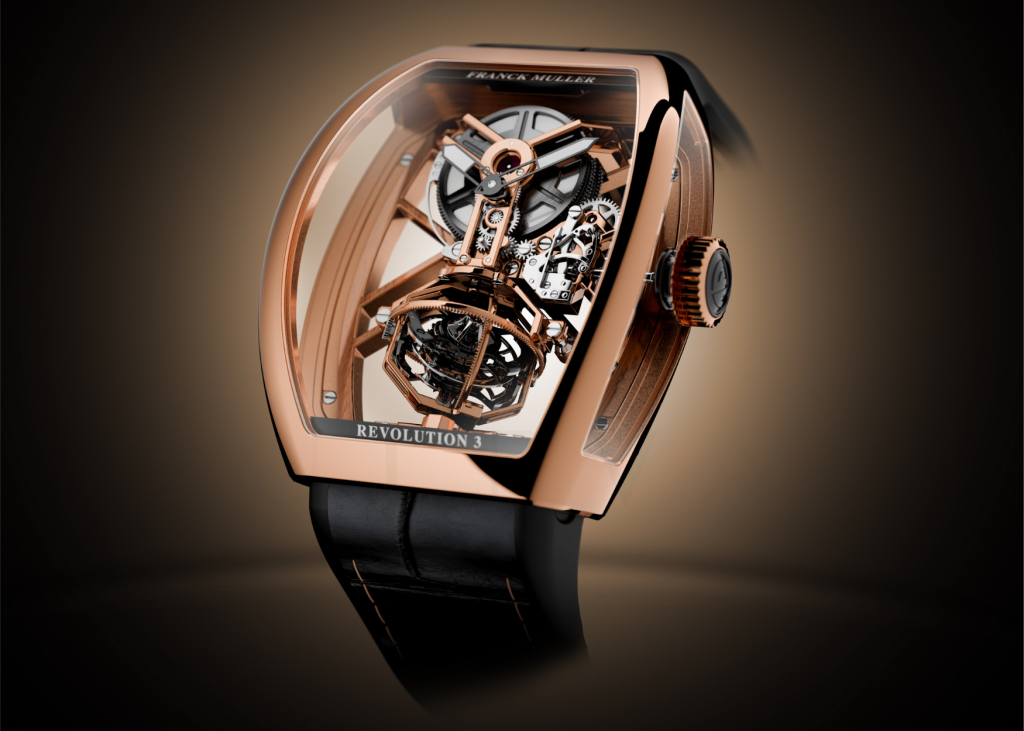
The Vanguard Aero Revolution 3 Skeleton unites an openworked architecture, an in-house movement and
the iconic tri-axial tourbillon in a striking three-dimensional composition. (Photo courtesy of Franck Muller)
This complication already exists in our collection, but we removed some retrograde indications around it. Normally, we have two hands around and a power reserve to indicate the time of rotation of each axis. We decided to remove those to be as transparent and as high as possible.
The challenge here was the spherical, curved case, which is very different from a flat case. So we kept the minimum amount of material to open everything as much as possible, and I think the result is really impressive. We also had the choice to make something easier—to put some metal behind the crown to help the water resistance—but we found a special technical solution, so we have only glass on the side as well. We have a corrector on the back—a special button at the bottom. It communicates with the crown to enable some functions. There are two barrels, and it offers 10 days of power.
This next one is a Master Jumper, an existing complication in our collection for about two years. This year we present it in the Tonneau Curvex CX. Before, in the Curvex, we only had a version with a dial. The idea [for the Tonneau Curvex CX] came from a discussion with our partner in Paris. At that time, the idea was to make something very elegant, very Parisian, very minimalistic.
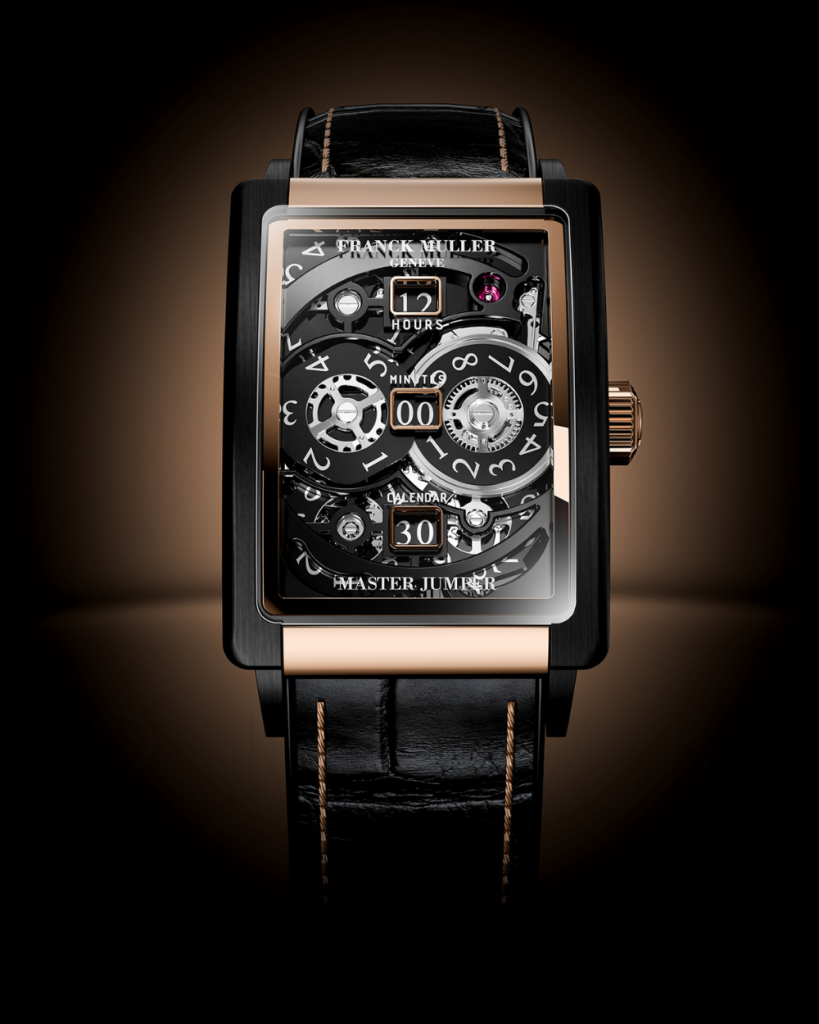
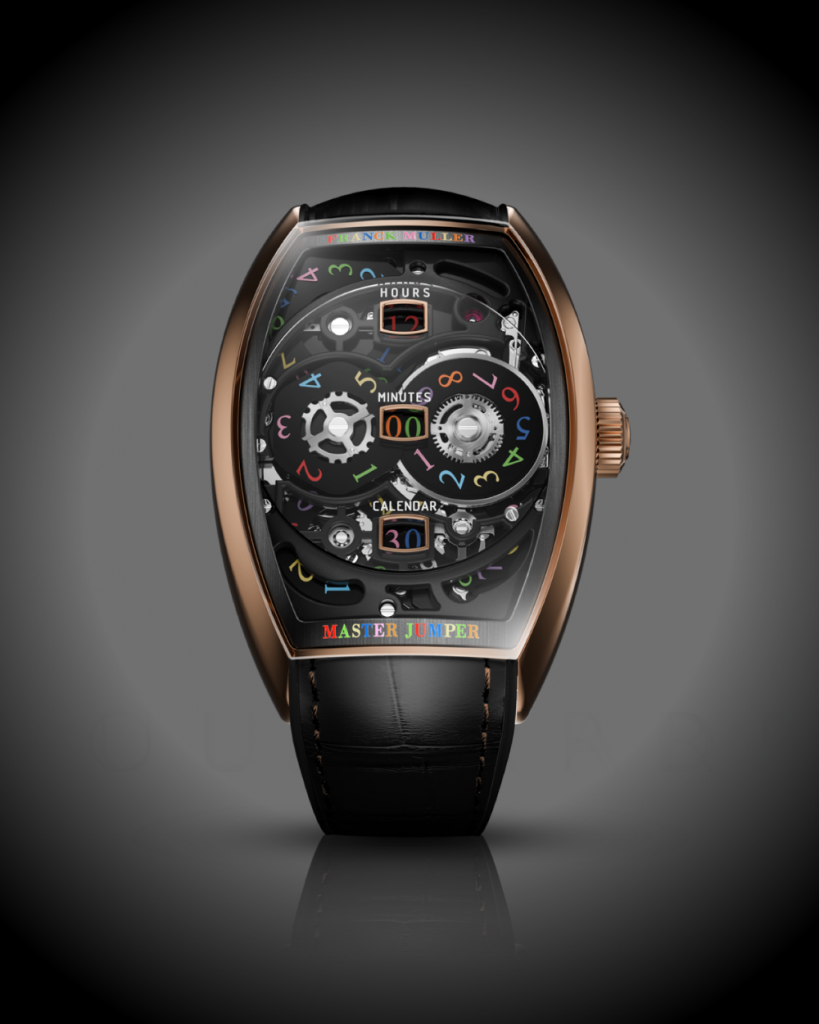
The Master Jumper Skeleton is housed in the Long Island Evolution case (left) or the Curvex CX case (right). (Photos courtesy of Franck Muller)
Now, the idea is to open it to show everything. When you have the dial on, you can’t imagine how complicated it is, how many discs are behind. Now it’s no longer a secret—you can see all the discs.
From the first sketches, we imagined this piece with a metal bracelet. In our existing collection, we normally think first of alligator straps or different materials, but we knew we needed a strong metal bracelet in the collection. So from the beginning, we designed it for the best integration with a metal bracelet.
We work a lot with curved carbon, and what we discovered is that when you change the diameter of the case, the texture and the pattern of the carbon become totally different. With a different diameter, it’s normally straighter. When we started to design this, it was to create a surprise—a surprise for us, because it’s a new adventure, but also for our partners and our clients. The idea is also to meet new clients because we’re opening a new door in our collection.
Art, sublimation and Gatsby influence
Glénat: This next piece is a special collaboration with an artist, like last year’s with Jisbar. Kelly Dabbah comes from Geneva, and she spent many years in New York creating her own art. It’s graphic and digital art; she’s had many opportunities to present her art on the screens of Times Square, for example. But she has also worked on fabric, on skateboards, on surfboards.
In the Vanguard Kelly Dabbah, you can see the eyes of the tiger in the centre, and you can see how many details she put inside her art—many roses, many flowers, many different things.
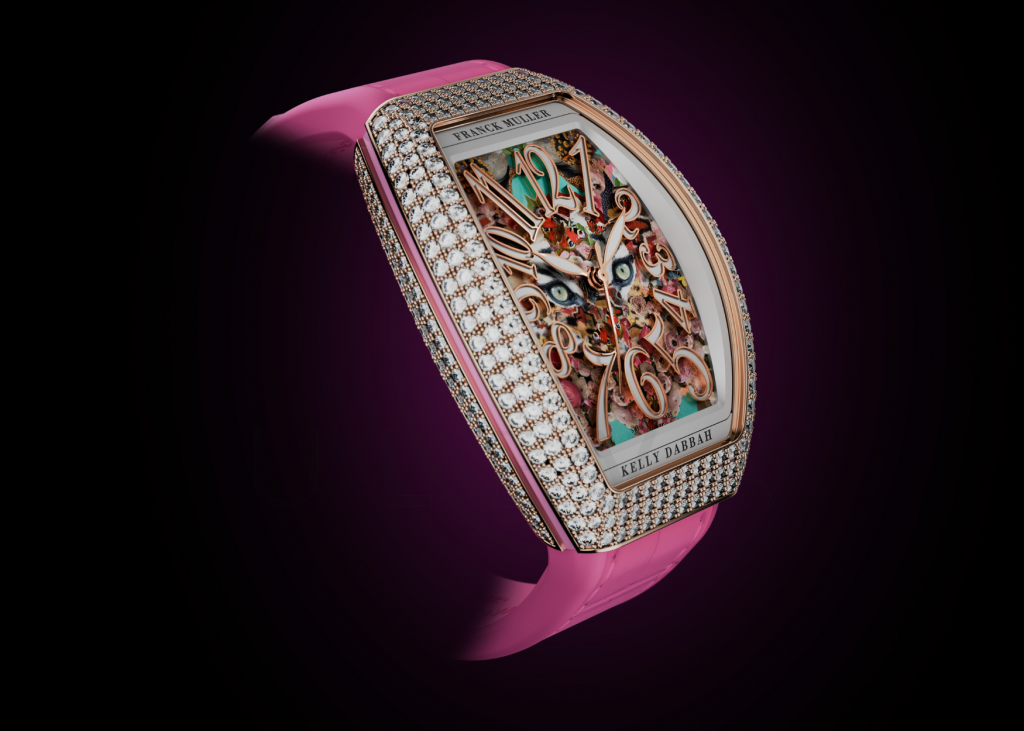
Multidisciplinary maximalist collage artist Kelly Dabbah lends her bold flair to new Vanguard models in materials like fibreglass. (Photo courtesy of Franck Muller)
The challenge for us was also to find the technical solution to have all these details at this scale. So we work with a technique of sublimation—it’s like a high-range printing solution. This is another execution with a fibreglass case. We’re able to mix different colours here—pink and turquoise. We have an anodised aluminium case that we developed over many years to really have a hardness of treatment.
For me personally, each collaboration with artists is very exciting because I can learn about other creative environments, and it’s very cool.
Then, because we love to play with numerals and numbers, [in the Cintrée Curvex Gatsby] we chose to take our inspiration from the Gatsby period. The style of numbers, really the feeling and the delicate taste, the graphic force. Also, because we have an Art Deco style, the match was very good. For the technical aspect, we worked to improve the thickness of each line—the gold lines—to be really more precise and feminine.
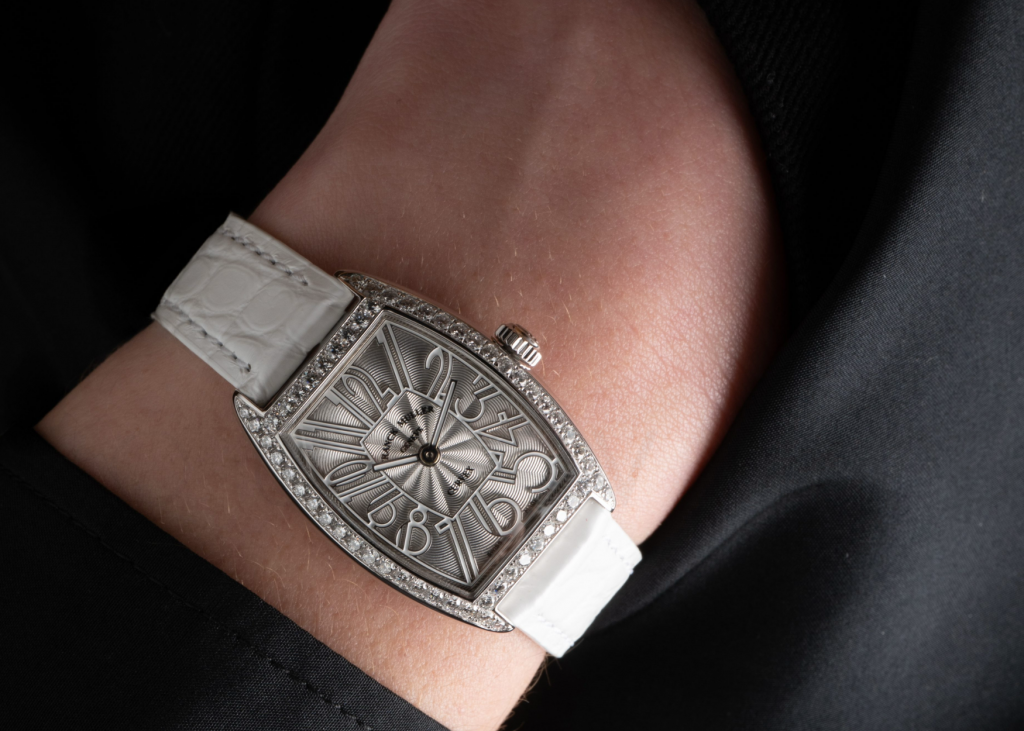
The Cintrée Curvex Gatsby unites the elegance of the Art Deco era with Franck Muller’s iconic Cintrée Curvex architecture. (Photo courtesy of Franck Muller)
Horology as an emotional bastion in today’s world
Glénat: Of course, [watches are] not essential when you think about it, but it’s emotional, and I think everybody needs to continue to dream, to feel emotion. We can be afraid or destabilised, but we have to continue to be human, to be sensitive and to continue to create. We don’t have to stop.
My role as a designer is to create emotion. I sometimes get the opportunity to meet clients, and it’s very important for me to understand the real emotion at the final step of the process. I would like to evoke the same passion from the beginning—that we have during the design process—in the lover or the buyer of the watch at the end. When I have the chance to meet this kind of client, it’s so exciting for me. And this is why I work.
Another situation is with artificial intelligence. I think it’s very important to have timepieces like these, real craftsmanship, because this is our history as humans. We don’t have to forget this kind of real thing that we can touch and feel. For me, it’s an object that lets us use our imagination. You feel free when you are alone. You have a special relationship with this kind of creation. No situation around can change this, I hope.
Go further with the 2026 edition of Watches and Wonders in Geneva.
Read next:
8+1 bed | 10,200 sqft area 19,500,000 SGD
5 bed 19,380,000 SGD
4 bed | 4,208 sqft area POA

3-8 bed | 699,654 - 784,080 sqft area POA
6 bed POA