Eliot Thomas cooked for people who could eat anything, anywhere, any time—at Magpie, in Singapore’s Tiong Bahru, he serves what they were really after
by Hamish McDougall
Photography by Jin Cheng Wong
There is a particular freedom in cooking for people who can have anything. Eliot Thomas spent his twenties doing exactly that: at 23, he talked his way into a superyacht galley in the south of France, and for years he fed guests who could summon any ingredient, to any anchorage, at any hour. What that world taught him runs against the cliché—and it is now the organising idea of a loud little restaurant in Tiong Bahru, Singapore: that the people who can have everything tend to want the least performative thing on the table. Flavour, not ceremony. Fresh, rather than fancy ingredients. Something delicious, put in front of you, made to be shared.
Thomas grew up with the tablecloths on the floor. His was a Fijian family in the pub-and-hotel trade—his mother from Fiji, his grandparents’ Indian influence in every pot—and the food arrived in bowls to be shared: taro, cassava, curry, raw fish, chutney. “That’s inherently the way we ate,” he says. “It’s really stuck with me.” Several kitchens later—the River Café and Spring in London, Stevie Parle’s Dock Kitchen at Portobello Docks, a superyacht galley in the Mediterranean—he moved his wife and two young children to Singapore, more or less sight unseen, to open a restaurant in a Tiong Bahru shophouse. Magpie runs on vinyl and a menu rewritten around whatever looks good that morning at the market across the road. There is no ceremony. Thomas calls the food “borderless”—a word his business partner landed on because Thomas cannot abide “fusion.”
“There are no borders, no rules,” he says. “Whatever goes on the plate and is delicious is served.”
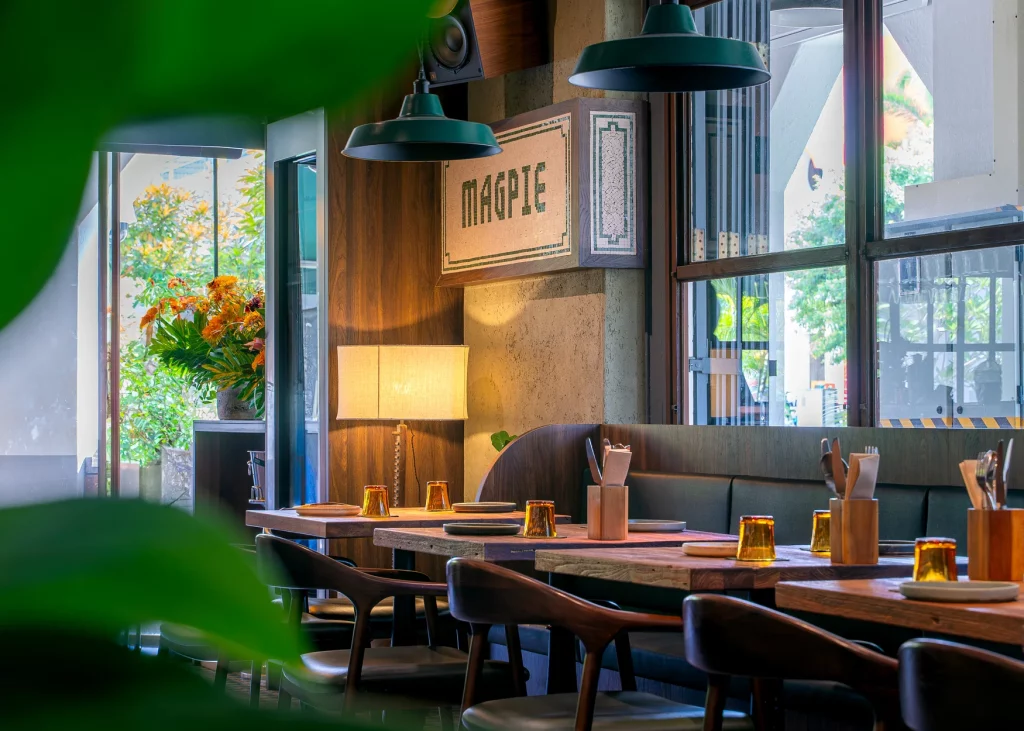
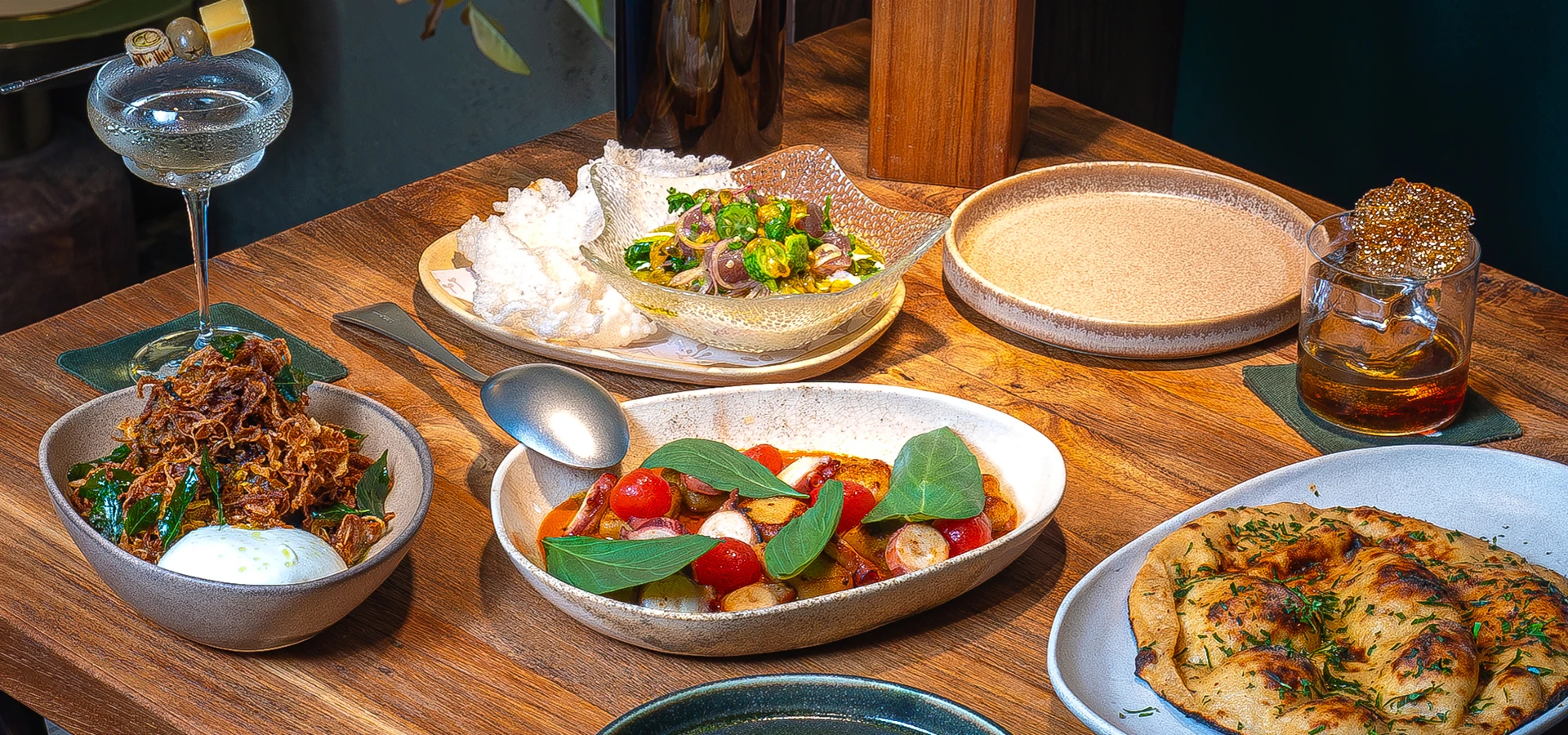
Magpie by New Zealand-born chef Eliot Thomas is a Michelin-listed restaurant in Tiong Bahru serving “borderless soul food”. Top: The curried pumpkin and burrata under a mountain of fried onions is a mainstay on the Magpie menu.
What the people who can have anything actually want
Thomas cut his teeth at the far end of private service. The work was less about grandeur than logistics: crew sent ashore to markets they don’t know, a galley expected to conjure the best from whatever a tender can carry, a plan that resets with the anchorage. “Provisioning is very difficult,” he says. “You might be in Croatia one day and Saint-Tropez the next.” The longest single stretch was three months without touching land.
The fantasy of that world—caviar, lobster, truffles to order—is only ever half the picture. Ask whether the money wants spectacle or a very particular club sandwich at two in the morning, and Thomas laughs. “Have you seen Below Deck? It’s the 2am phone call: ‘can I get a club sandwich?’ [And the answer is,] ‘Sure.’ You’ve done eighteen hours, but you get up and make the club sandwich. That’s the job.”
So he is worth listening to on the question the rest of us can only guess at. What he came away with was not a flavour.
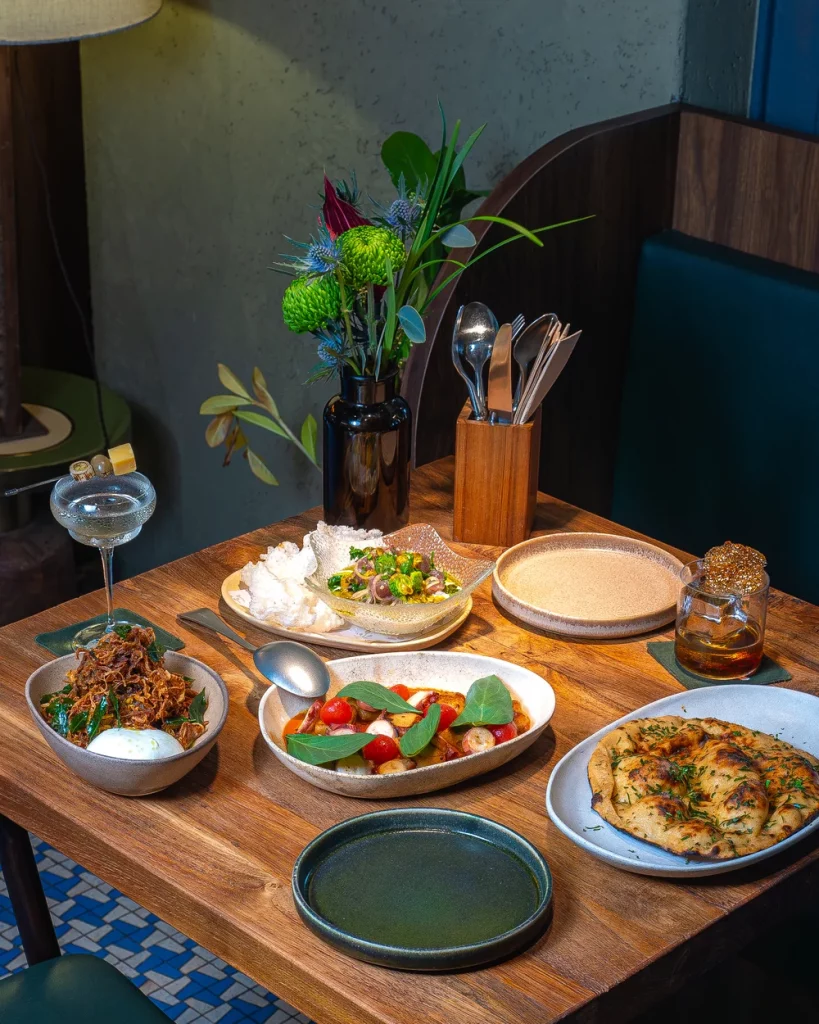
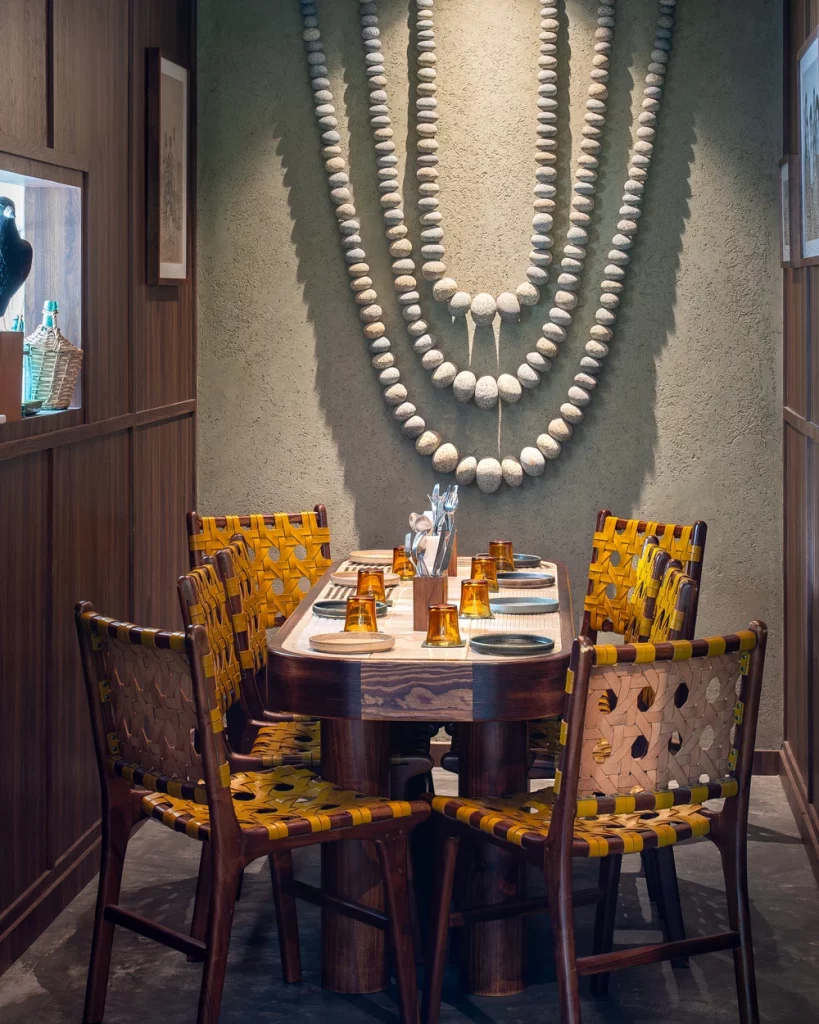
Left: Rooted in fresh, seasonal produce, Magpie’s menu is constantly evolving, save for a few mainstays that beckon regulars. Right: Set in a Tiong Bahru shophouse, the restaurant features relaxed and eclectic interiors.
The luxury he was hired to produce, in other words, was never on the plate. It was the plate’s ability to hold a table together for an evening. “Family time. Time is something you can’t buy. How to create a moment with your family when you’re on holiday. As a dad, there’s nothing more special. At the core of it, that’s all people want, more than anything.”
Reading the table
If the yachts taught him anything portable, it was that the craft is not the cooking. “I don’t think it’s the food,” he says of the hardest thing to get right. “It’s reading people—knowing their expectations before they even know them. That’s the ultimate form of hospitality.” Three years cooking one family’s preferences on a loop became “robot work” by the end, but it drilled in the timings, the standards, the read. The tell of a good private chef, he says, is knowing which service the room wants: “They want something delicious. Then, depending on how you’ve read them, they want you to come and explain it—or to put the food down and step away.”
It is the one habit he refused to leave behind. Now that Magpie has found its feet, he is back out of the kitchen and onto the floor. “That’s what I loved most about private dining—the storytelling, feeding off people’s energy.” The room he is reading is simply larger, and a good deal louder.
The pub rat
Magpie is, by his own cheerful description, “the polar opposite” of a superyacht—and that was the point. “My parents owned pubs. I was called a pub rat. The music, the people, everyone having a good time—that’s what I always understood hospitality to be.” The white-tablecloth track never tempted him; even in London he steered toward the River Café and the Dock Kitchen, where under Stevie Parle and head chef Alex Jackson he learned to pull a dish from anywhere—”we’d run menus from a region of Morocco”—and make it his own. “That grounded me in the freedom to cook and express.”
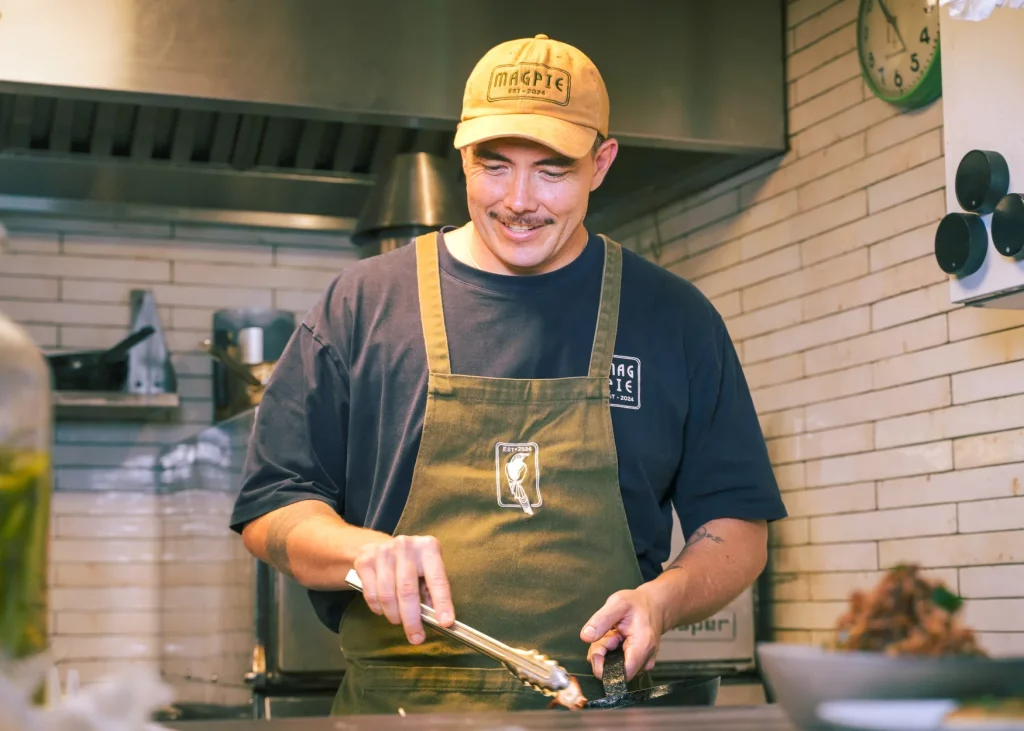
Magpie’s chef and founder, Eliot Thomas, in the kitchen.
The through-line from the galley, then, is not the polish; it is the conviction that the good part was never the ceremony. What survives translation from one owner’s table to a 40-seat shophouse is the instinct to feed people generously and read them well—only now the table is communal, and the tablecloths are, once again, more or less on the floor.
What it means on the plate
Ask Thomas to define luxury in food now and he strips it to a single variable. “Things can taste elegant without being strategically placed on a plate—mad respect to the people who do that. But flavour is paramount, and to me that’s luxury.” The cooking is deliberately un-tricksy—ingredients-led, local, seasonal—which in Singapore is harder than it sounds. “Food comes in from everywhere, every season, so the job is knowing what’s actually eating well. I can get a peach from South Africa out of season—it won’t be delicious.” So he reads the market reports, crosses the road to the wet market, and pairs what’s local with whatever is genuinely at its peak elsewhere. A core menu holds the dishes regulars come back for; a fast-changing specials list is where he keeps learning—”every day is a school day”—guided by a line he has borrowed from the London restaurateur Jeremy King: “What’s the fastest way to go bankrupt? To maintain your standard.”
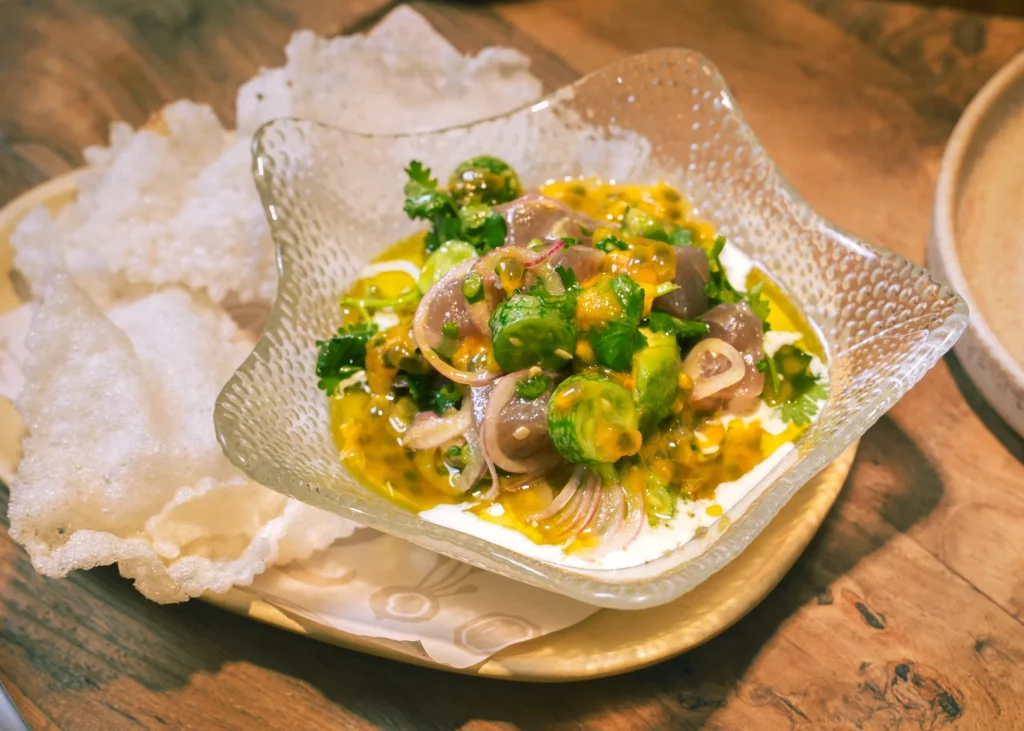
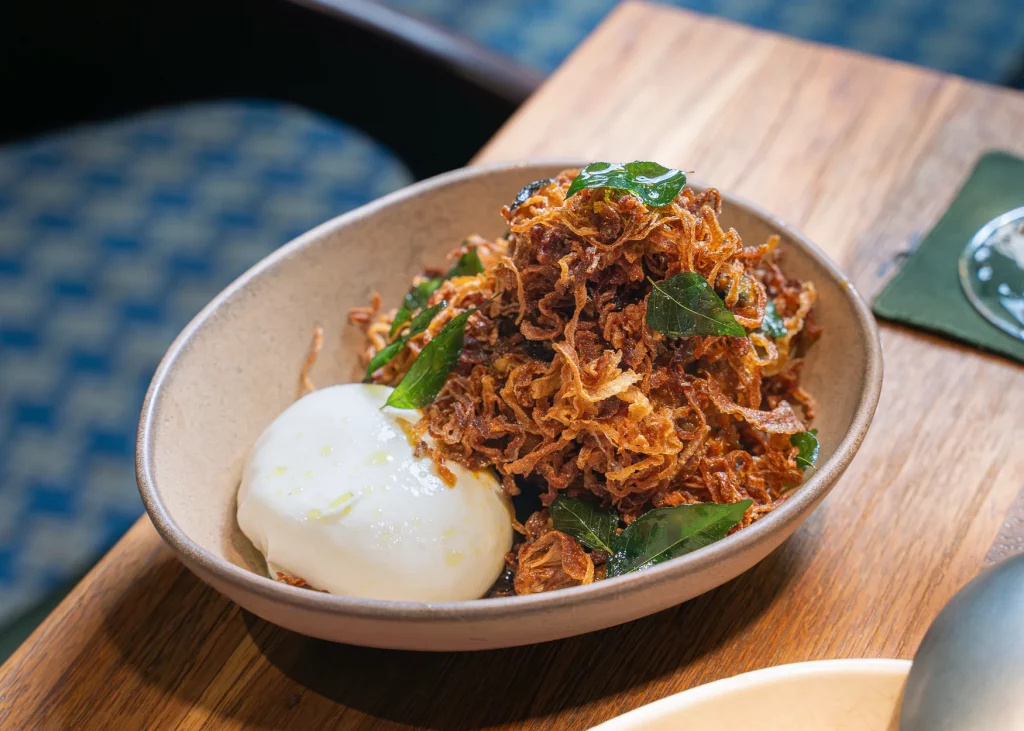
The ingredients-led dishes at Magpie are designed to catch you a little off guard.
What that produces is best explained at the table. The burrata—the dish you would ordinarily overlook—is set off, beautifully and unexpectedly, by a sweet, savoury, deeply spiced pumpkin pickle and a crackle of crisp onion. A curried crab croquette is, truly, more delicate than it has any right to be, held in balance by a piccalilli and a parmesan mayonnaise that, rather than trampling each other, resolve into something elegantly complex. A special of gnocchi and octopus is bound in a richly enveloping nduja sauce whose savoury depth gives way to a slow, comforting heat that builds as you eat; by the end, only the barest scrapings are left. A slow-cooked lamb shoulder, refreshed with coriander and ginger, arrives falling off the bone and—tellingly—with its own bowl of gravy, to keep it replenished through several indulgent helpings.
It is a register Singapore has been oddly short of. You can eat superbly here for the price of a hawker plate, or at full Michelin tariff, but rarely like this in between: cooking this considered in a room this relaxed, where every dish invites a greedy second round, where more tandoor bread is ordered simply to chase the last of a sauce, and where the flavours run complex—occasionally challenging—yet land as deeply satisfying, moreish and memorable. Which returns you to the thing Thomas learned feeding people who could summon anything: what they wanted, in the end, was to be fed like family. At Magpie, so is everyone else.
Read next:
- On board Luminara, The Ritz-Carlton Yacht Collection’s Asian debut
- Samara Lombok: Inside the 150-hectare, Hyatt-backed resort-residences on Indonesia’s next great holiday island
More luxury travel and dining.
In brief:
Eliot Thomas is the New Zealand-born, Fijian-heritage chef-owner of Magpie in Singapore, who cooked as a private chef on Mediterranean superyachts—and trained in London under Stevie Parle—before opening in Tiong Bahru in 2025.
The food. Thomas’s own term for it is “borderless soul food”, chosen to sidestep “fusion”: food with, as he puts it, “no borders, no rules”—drawing freely on his Fijian and Indian heritage, his French training, and whatever the market offers that morning.
What should you order at Magpie? The burrata with curried pumpkin pickle and crisp onion; the squid chop grilled over the market’s daily catch; and whatever is on the specials board.
8+1 bed | 10,200 sqft area 19,500,000 SGD
5 bed 19,380,000 SGD
4 bed | 4,208 sqft area POA
3-8 bed | 699,654 - 784,080 sqft area POA
6 bed POA