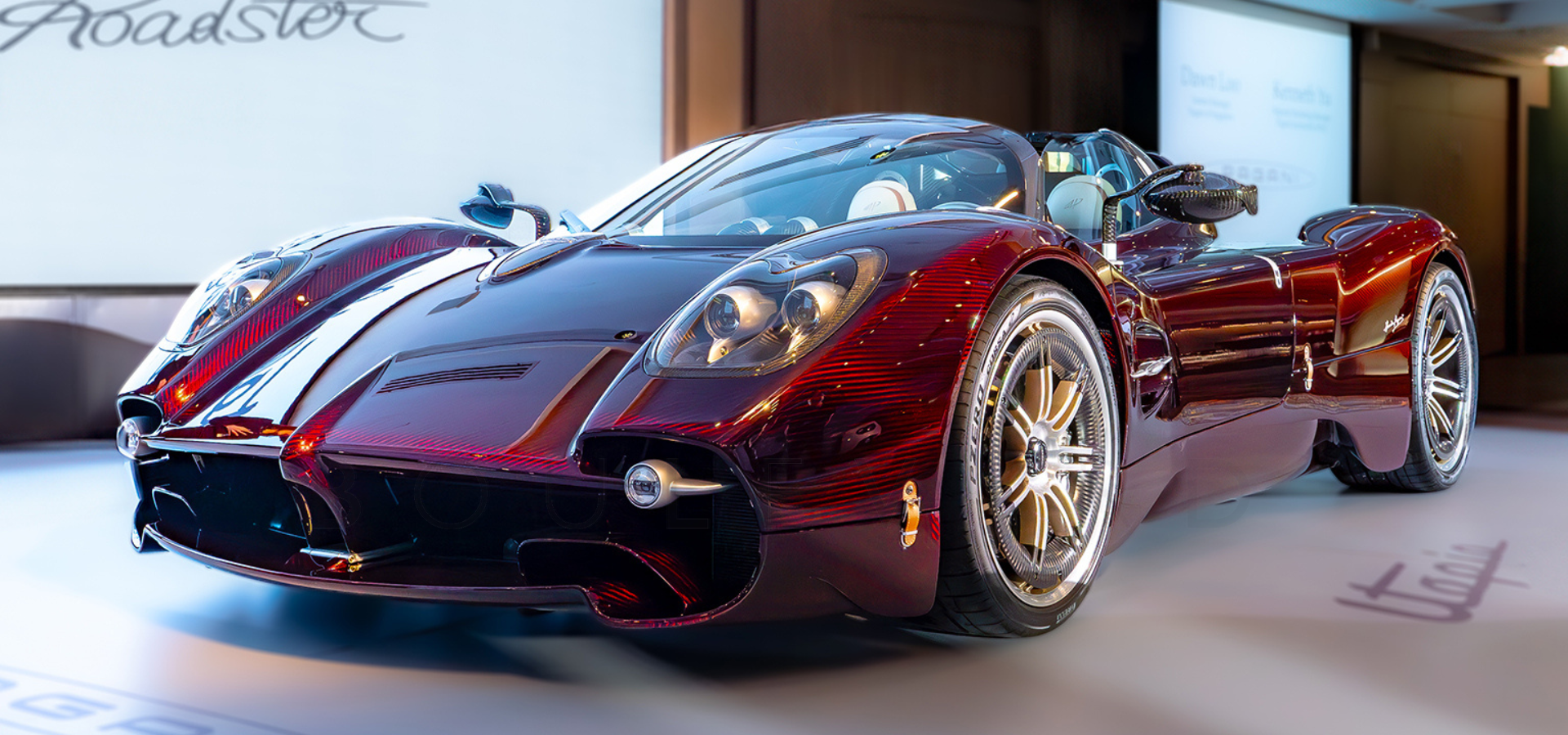
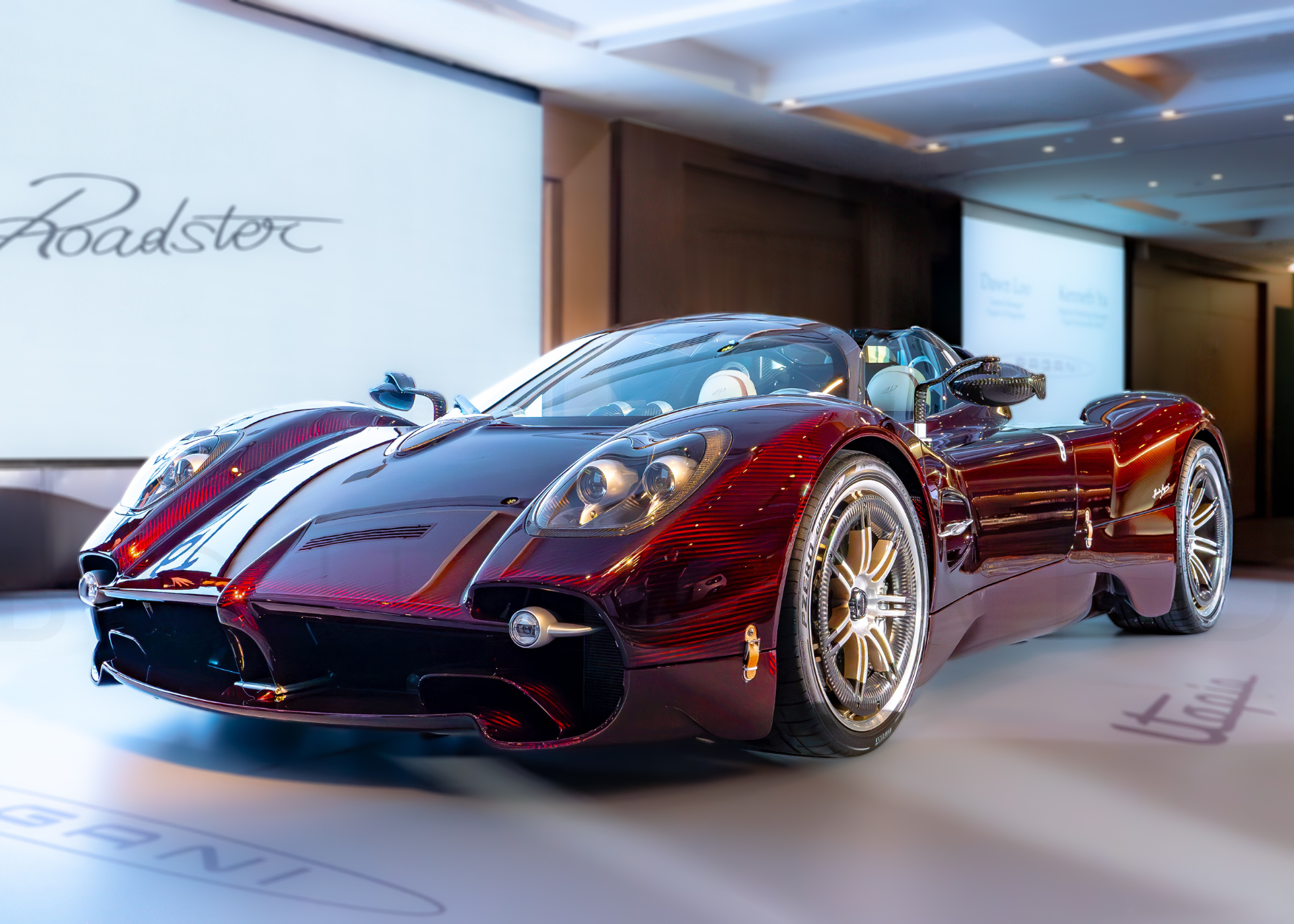
No longer is cleanliness akin to luxuriousness, especially when it comes to the cabins of our automobiles. We examine the analogue renaissance happening within the automotive market.
When Apple’s former chief design officer and one of the most influential industrial designers of our time, Sir Jonathan Ive, created the iPhone’s touchscreen, it was an everything control solution for an everything device. However, he never intended it to be an everything solution for every product, especially our cars.
Fast forward to 2026, amid a period where carmakers have adopted the touchscreen en masse, and by heading up the design of the new Ferrari Luce, Ferrari’s first EV, we finally get Ive’s vision of what he feels a luxury car’s interface is supposed to be. What’s missing? A giant touchscreen. And in its place, a smaller, movable screen attached to a ball joint; buttons, switches, and knobs that control everything, all made from satisfying-to-touch anodised aluminum and glass.
When the car’s interior was revealed a few months ago, Ive expressed his disdain for the big screen revolution his designs so inspired, echoing a sentiment felt by car lovers all over the planet—that the car is not a personal device, and a central screen controlling everything is simply not practical. Let alone pleasing, nor luxurious to use.
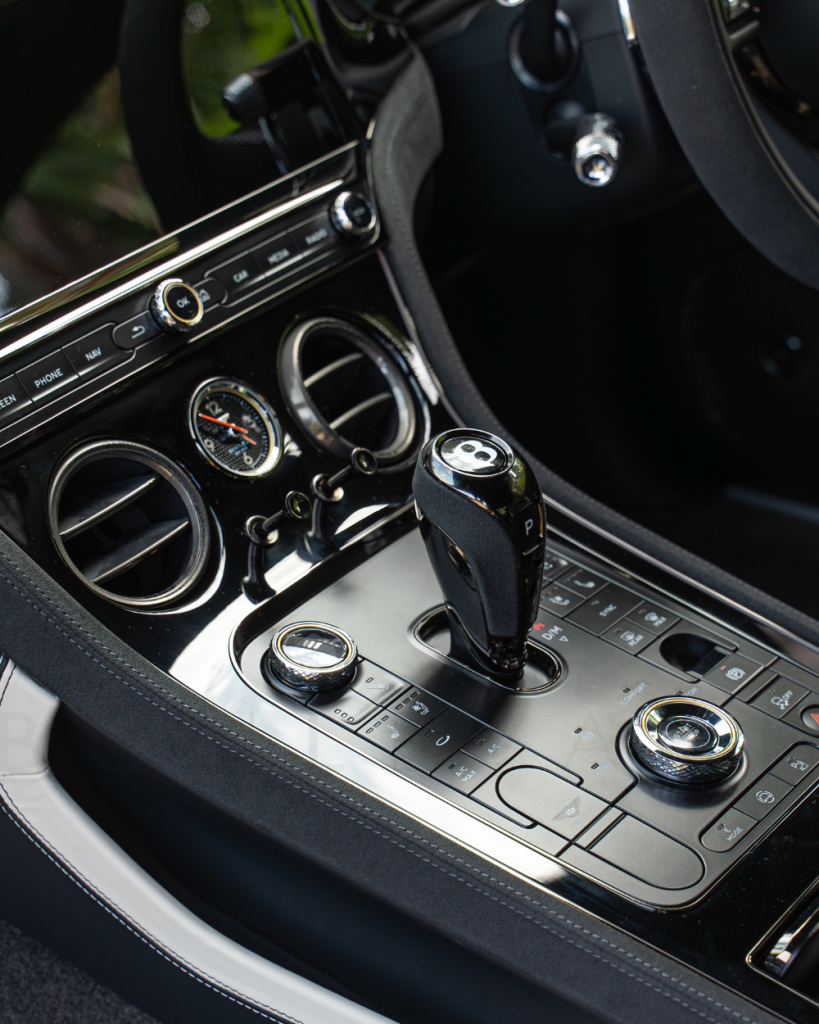
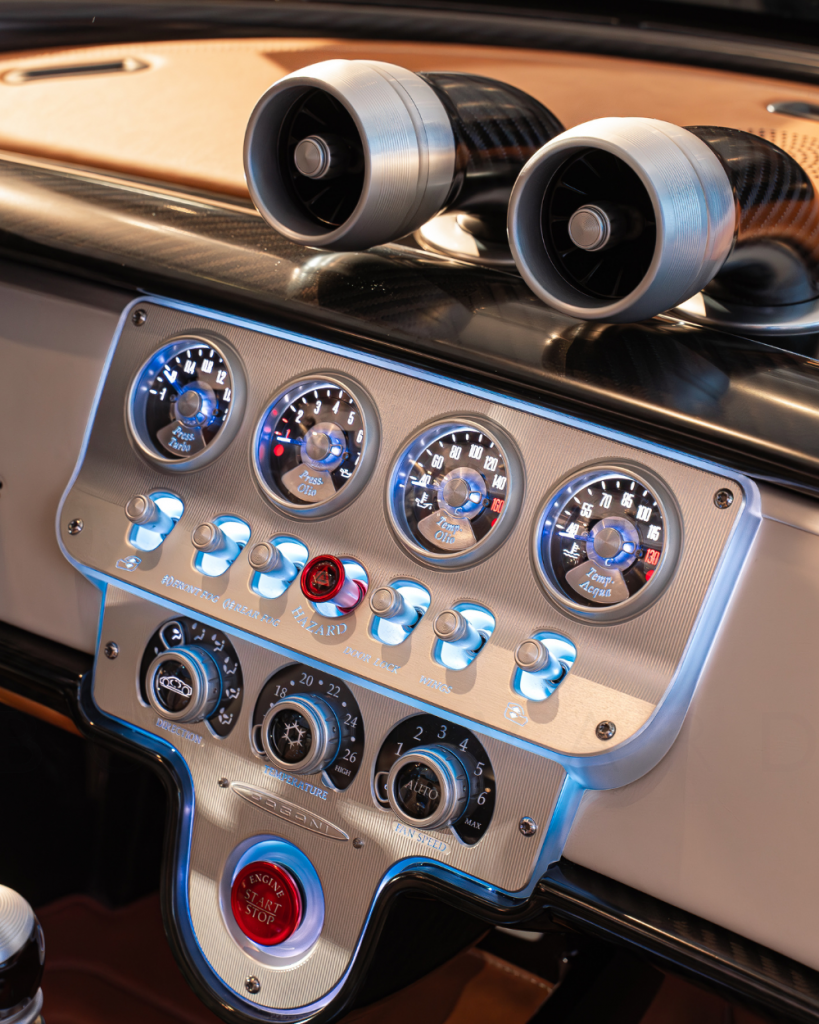
Left: The centre console of the Bentley Continental GT, complete with knurled organ-stop AC controls. Right: The analogue display on Pagani’s Utopia Roadster. Top: The Roadster also throws back to the leather body latch, as a decorative nod to vintage racing.
In the past few months, the wider automotive industry has undergone a backflip of some degree. Car safety bodies across Europe, Australasia, and China are converging on the same conclusion: that touchscreens are a dangerous driving hazard. This has led to new regulatory standards that require manufacturers chasing five-star safety ratings to bring physical controls back for some elements—such as indicators, hazard lights, horn, windscreen wipers and e-Call emergency system—many of which have been relegated to the touchscreen’s menu on some cars. Europe moved first, and while China following suit is one few saw coming, it makes sense if it wants its cars given top-safety gongs worldwide. The Chinese market prides itself on its safety ratings and technologies, but it’s also the market that did more than anyone to normalise the all-touchscreen cabin; and in turn, reshaped how the industry is once again viewing analogue as luxury.
Technology-as-a-marker-of-status will always suffer from mass adoption, and particularly within the automotive industry, it’s a tale as old as time—almost every normalised technology we have in our vehicles was once a high-end flex. Once seen as a marker of luxury, the high-definition screen and minimalist tech-centric cabin stopped being an item of status the moment it became mass-produced, especially when a $50,000 hatchback and a $500,000 supercar have near-identical software and in-cabin experiences. For the high-performance automakers, the aviation and racecar-inspired cabin experiences will always be central to how we relate to their cars—they elicit a feeling of control, speed and emotional exuberance—it’s also why Lamborghini has the phrase “feel like a pilot”, and why it’s never bent to the minimalist cabin trend.
Look at the timeless design of the Bugatti Veyron, now 21 years old; it’s a masterpiece of tactility, millennial modernity, and the right balance of minimalism without overwhelm. A luxurious aluminum alloy and brushed aluminum were specially developed for the interior design, and engineers and designers worked hand-in-hand to craft a feeling of form-meets-function with high emotion. Everything you need is at your fingertips, and it feels exquisite. Then, there’s the Pagani Utopia Roadster, a masterpiece dressed in sumptuous carbon fibre—you know exactly from looking at its highly engineered exterior that the driving experience is going to make you feel like a fighter jet pilot. Everything is placed just where the driver needs it, with analogue dials that softly glow with a sense of nostalgia and resemble the aesthetics of high-end horology. The screen itself is dark, subtle and not at all intrusive to the overall driving experience—to cover the fascia and central cockpit in an enormous screen would be deemed sacrilegious.
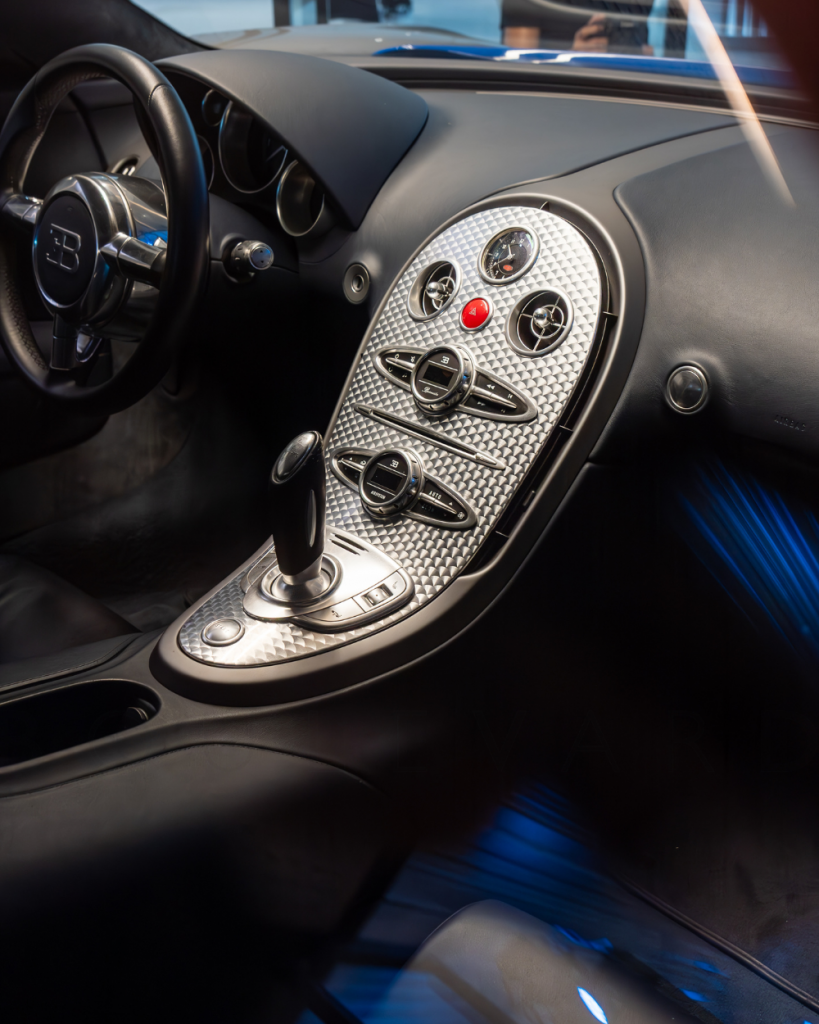
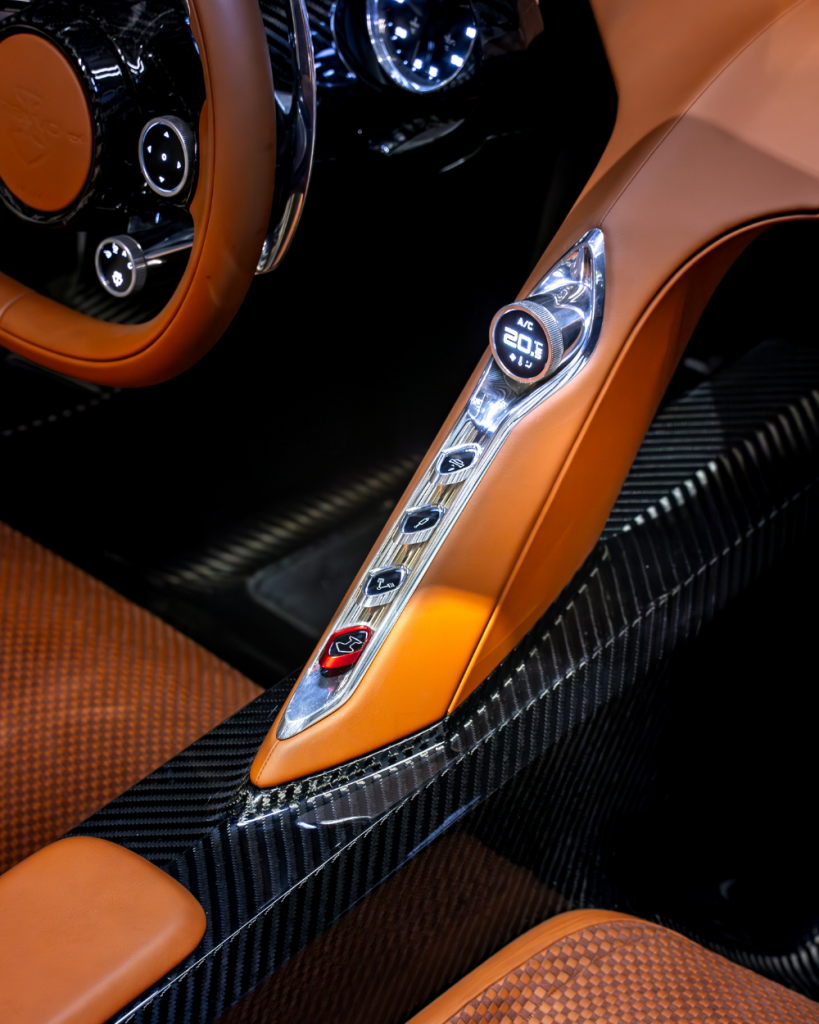
Left: The Bugatti Veyron’s dual-clutch gearbox. Right: Centre controls on the Zenvo Aurora.
Some automakers have realised they’ve gone too far, including Mercedes-Benz, which is the worst super-screen offender with its 39.1-inch MBUX ‘Hyperscreen’ that covers almost the entire width of the dashboard. Just a few months ago, the Stuttgart prestige marque announced that the upcoming GLC and C-Class will still offer the‘ Hyperscreen’, but with physical buttons and switches returning to certain areas in the centre console and on the steering wheel.
In an interview with Autocar, Mercedes-Benz Sales boss Mathias Geisen said the brand has changed its course due to customer demand. “Customers told us two years ago, ‘guys, nice idea, but it just doesn’t work for us’, so we changed that and made it more analogue,” he said. Perhaps the most significant backflip in recent history was Ferrari, which made a dramatic redirection due to customer demand. It introduced a haptic touch-capacitive steering wheel on the SF90, which then appeared on the Roma, 296GTB and others, on the theory—explained by then-commercial boss Enrico Galliera—that faster touch response found on a smartphone should translate to a car. It didn’t: “We didn’t consider then when you use it, you’re also driving,” he said at the time, noting the unhappiness of its customers.
The Amalfi, launched in 2025, and the just-launched Amalfi Spider, reversed course with real buttons and the return of the iconic round red start/stopswitch. Ferrari has since begun retrofitting the same fix into existing Roma and SF90owners’ cars, as an option.
In the 911 GT3, a car designed for pure on- and off-track pleasure, Porsche attempted to find the balance between tech and heritage. Instead of being tempted into adopting the wide-screen aesthetic that stretches across to the passenger found in its other road cars, the Stuttgart marque stripped back the cockpit. The new 12.6-inch driver display has an option called ‘Track Screen’, which takes this further, and strips back the digital displays to the left and right of the rev counter so that only data relevant to driving such as tyre pressure and temperature, oil pressure, oil temperature, fuel level and water temperature are visible—everything you need and nothing you don’t. Though it still has a central screen for all the modern-day connectivity needs, albeit amore rational, smaller one.
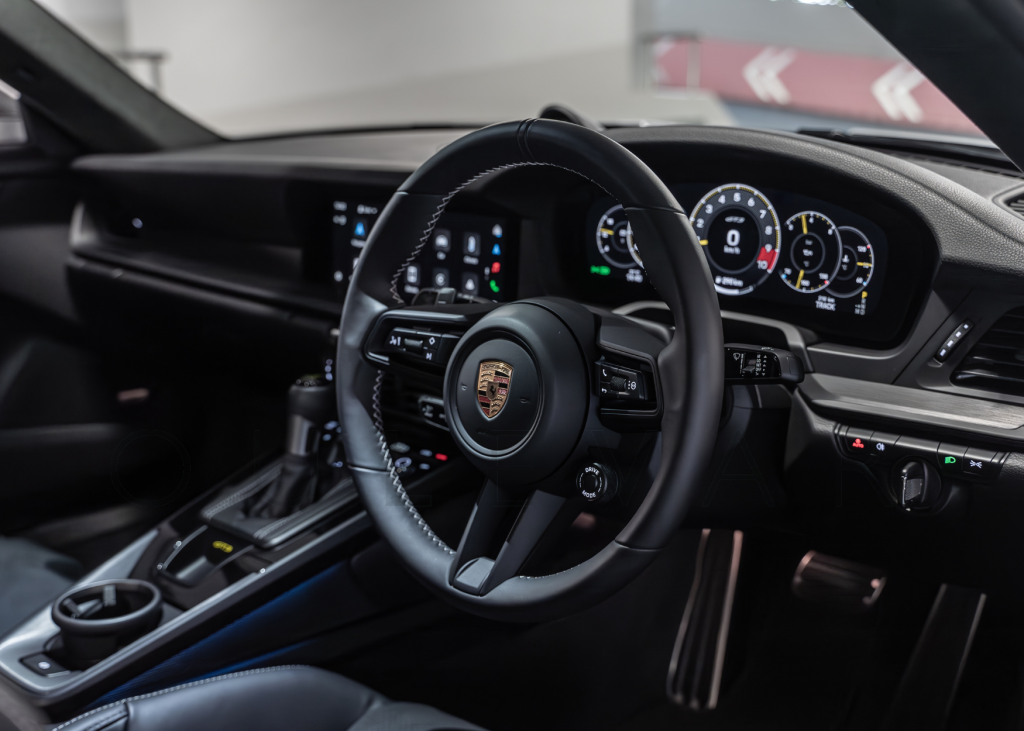
The Porsche 911 GT3’s driver-focused cockpit.
There’s a wider cultural pushback at play too: being offline is now a marker of status. And more broadly, luxury has been on the anti or rather, de-tech train for some time. We’ve seen the rise of the ‘dumbphone’ and film cameras, and how the fountain pen and paper planner have become objects of aspiration for a generation raised on keyboards. Increasingly, restaurants, hotels, private members’ clubs and even nightclubs are enforcing no-phone policies as a house rule. Even the resurgence of print and literary book clubs are signals of this too—a pushback against being tied to a feed designed to sell you stuff and, importantly, take away two of our most precious commodities: time and attention. Then, there is the growing concern around the collective fatigue, brain fog, and anxiety scientists say is being caused by modern society’s screen addiction, all of which are becoming more and more aware of. Therefore, for some brands, the anti-screen strategy is not just for high-performance feels, but one rooted in serenity and wellbeing.
Bentley clocked on to the growing desire for a digital detox early on, and has consistently been one of the luxury marques paying close attention to the growing desire for fewer screens. First introduced in the third-generation Continental GT in 2017, and continues in the Flying Spur and fourth-generation Continental GT today, is the Bentley three-sided rotating display, a luxurious anti-screen option for those who seek serenity. The central 12.3-inch high-definition touchscreen can be flipped around to reveal either a plain panel or a trio of analogue dials (temperature, compass and chronometer).
Rolls-Royce has a similar approach, and notes that its clients seek sanctuary, above all. While its newer models, like Spectre, still have the latest technologies, the British luxury house has put a focus on the physical— hard buttons, an analogue clock, ‘organ stop’ vent controls that pull rather than swipe, real dials for fan and heater. And by doing so, uses technology less as a central point and more as a necessary accessory that, when done right, can complement the interior’s high level of craftsmanship.
Read next:
8+1 bed | 10,200 sqft area 19,500,000 SGD
5 bed 19,380,000 SGD
4 bed | 4,208 sqft area POA

3-8 bed | 699,654 - 784,080 sqft area POA
6 bed POA