“Not every gemstone can be Miss Universe,” says Yadanar Gems founder Moe Moe
by Karishma Tulsidas
Photography by Kevin Khng
Shot on location at the Phillip Jeffries showroom in Singapore.
“Natural gems are limited editions from earth,” says Moe Moe with a small laugh, recalling when she bought her very first gemstone, a small ruby, 35 years ago. “Compared to now, the price was very cheap,” she recalls.
Over the years, she built up her private collection of gemstones, and that perspective would shape the foundation of Yadanar Gems. After earning a degree in software engineering, Moe Moe joined her family business in food products and moved to Singapore from Myanmar.
She put her career on hold and focused her attention on the family, while simultaneously pursuing her passion for gemstones and slowly racking up courses over the years. Finally, in 2022, her dream came to fruition when she set up Yadanar Gems, a Singapore-based jewellery house known for its focus on investment-worthy, natural and unheated stones.
“In my journey of collecting stones, I saw many stones and jewellery pieces, but often they were too expensive, or simply not special enough,” says Moe Moe. “So I set out my plan for Yadanar Gems, and I chose to buy only natural stones that were not treated and not heated.”
This guiding principle would soon become the hallmark of Yadanar’s identity, setting the brand apart for its dedication to authenticity and rarity.
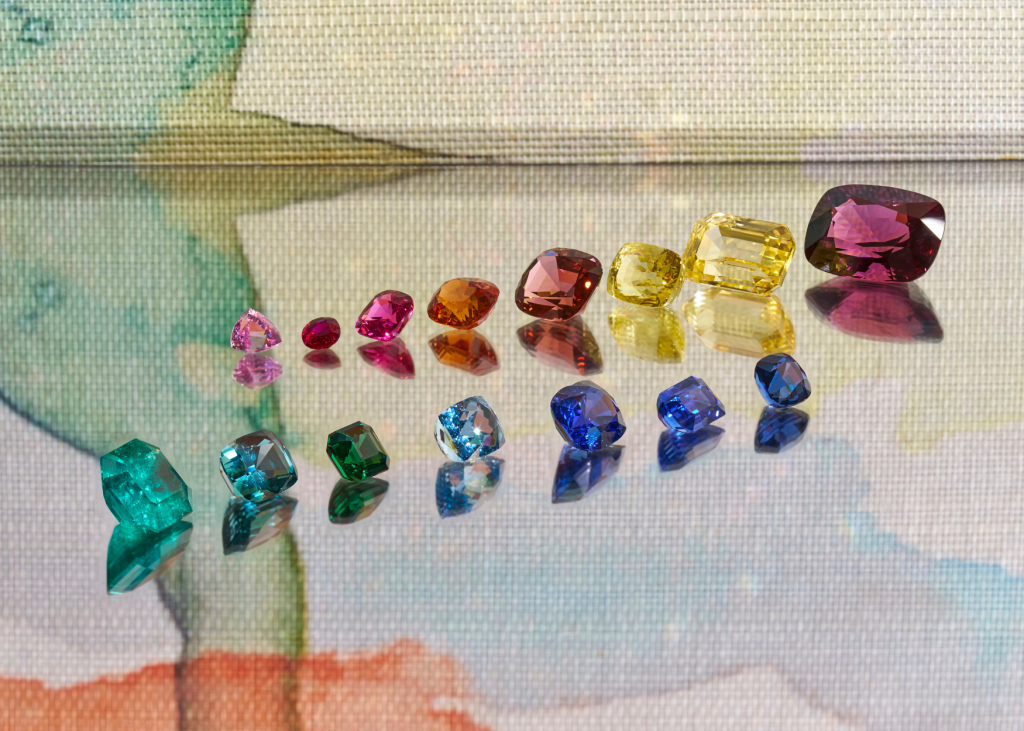
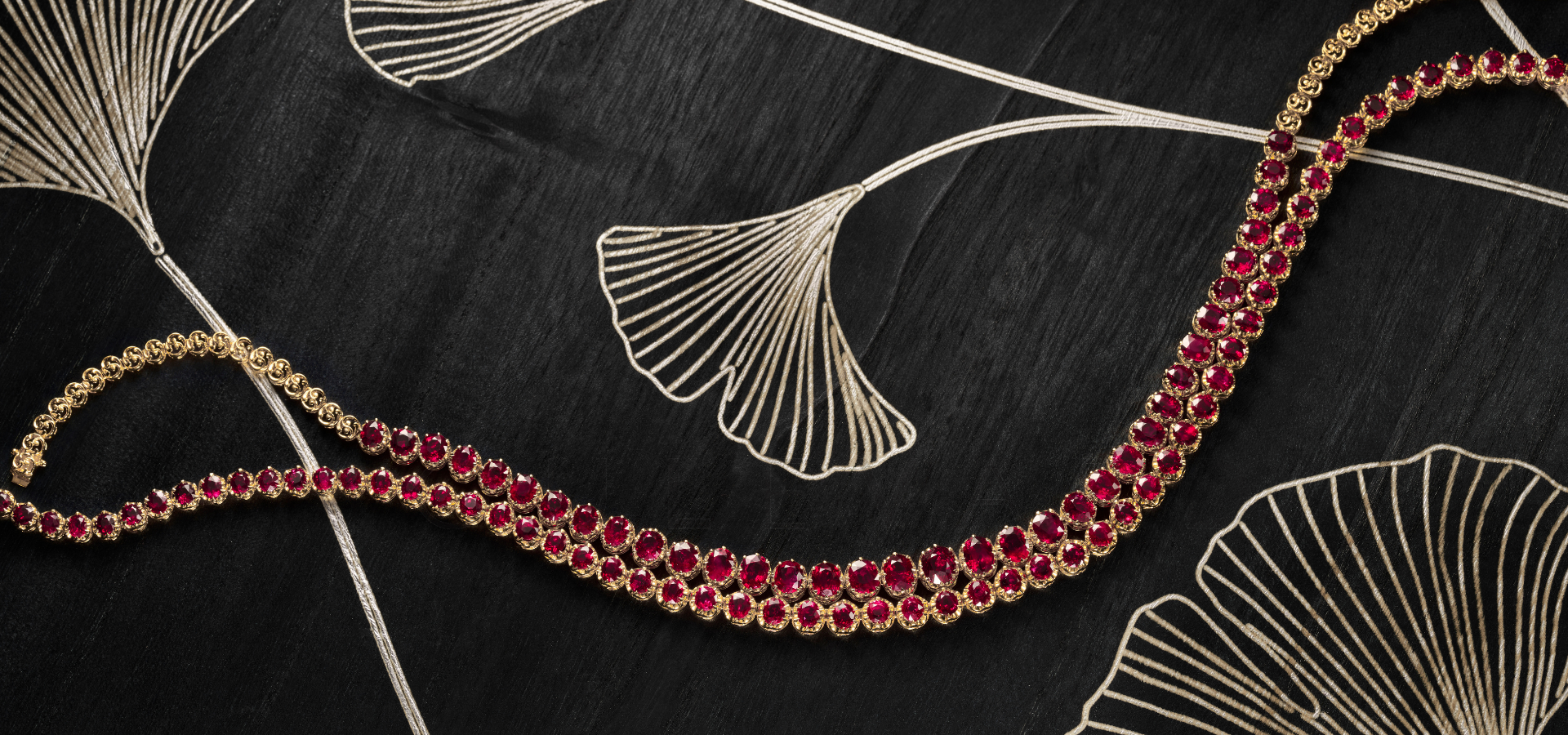
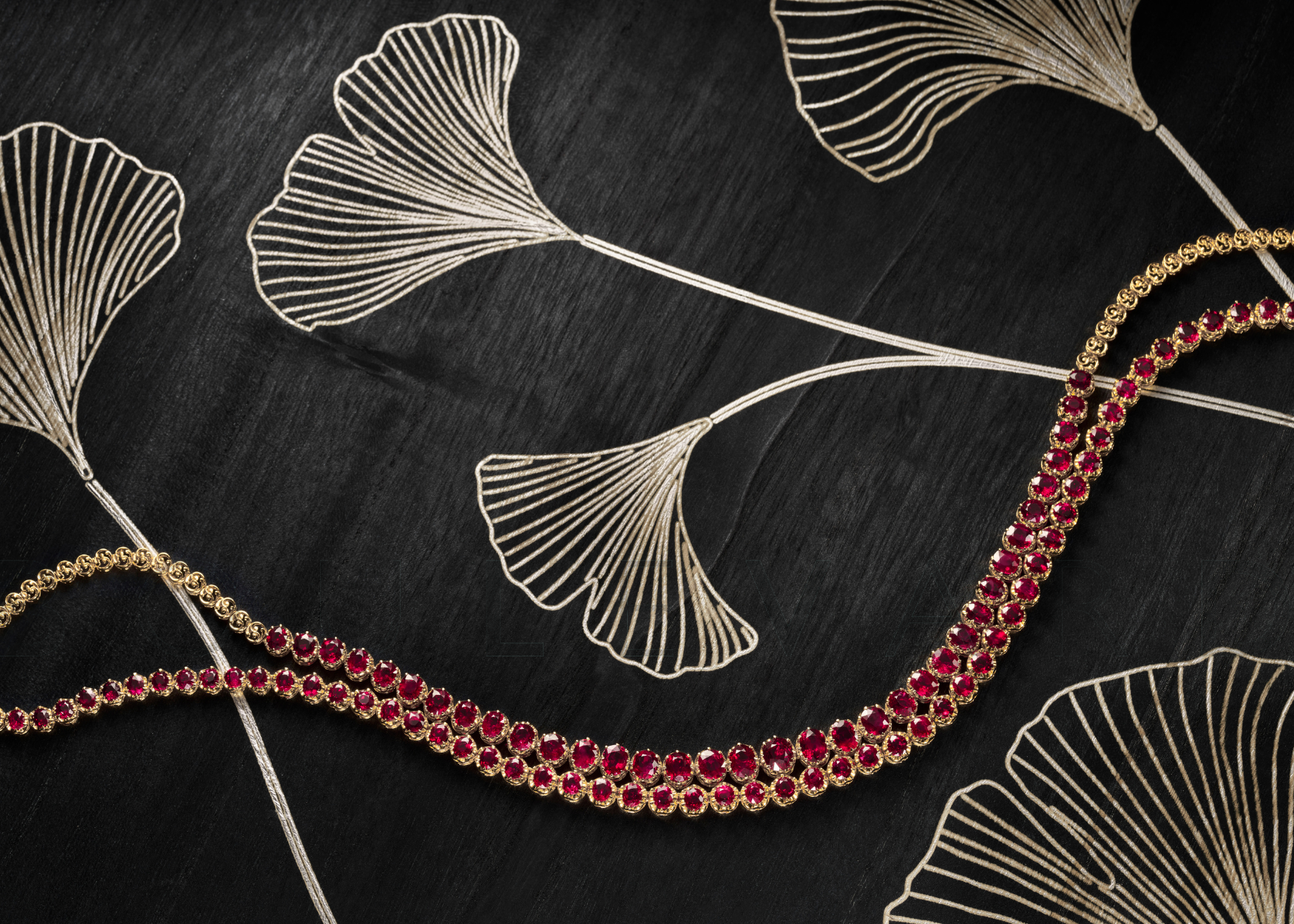
Coloured gemstones, including a 45-carat spinel, vivid green emerald, pigeon’s blood ruby, and rare sapphires; “Blur 7800” Manila Hemp in multicolour by Phillip Jeffries. Top: Two necklaces set with 47.77-carat and 56-carat of cushion-, oval- and round-cut pigeon blood and Burmese unheated rubies; “Gingko Garden 32204” wallcovering in Cypress Glow.
More than 90 per cent of gemstones are usually treated or heated to improve their colour, clarity and durability. This is even more prevalent with rubies, sapphires and emeralds, which tend to have inclusions. By maintaining this uncompromising approach, the brand has cultivated a reputation for exceptional curation, appealing to collectors who value purity and provenance.
Deciding to only work with investment-grade natural, unheated and untreated gems automatically limits and filters the stones that Moe Moe acquires—she rejects more stones than she accepts, demonstrating the standards that Yadanar Gems sets for itself.
“I wanted to build a business focused on rare and exclusive gemstones, especially for those who are truly passionate about collecting coloured stones,” she explains. “These are incredibly scarce, and they can serve as an alternative form of investment and something meaningful to pass down to the next generation, as a legacy.”
Her Burmese heritage also means she has access to some of the world’s most extraordinary stones—after all, the region is known for producing the coveted “pigeon blood” rubies, as well as jade, sapphires, spinels, peridots and more.
This scarcity further elevates Yadanar Gems’ offerings, positioning the brand as a trusted gateway to some of the world’s most sought-after gems.
Red hot demand
Yadanar Gems’ by-invitation-only showroom on Orchard Road is where the magic happens; like a child at Willy Wonka’s chocolate factory, I carefully nestle royal-blue sapphires, Colombian emeralds, green diamonds and rare rubies in my hand, ooh-ing and aah-ing at their vivid colours.
One of the highlights is undoubtedly two necklaces with Burmese, pigeon blood rubies. The first features 35 oval, cushion-shaped rubies weighing a total of 47.44 carats, while the second has 85 Burmese unheated oval-, cushion- and round-shaped pigeon blood rubies, totalling 56 carats. It took Yadanar almost three years to complete both strands.
Says Moe Moe, “Stones of that size, in consistent colour and quality, are extremely hard to come by. The larger the stone, the fewer options you have. I had to source them slowly, and during that time, prices kept changing. When you’re building something from individual stones, the value comes from the entire journey—from the very first stone all the way to the finished necklace.”
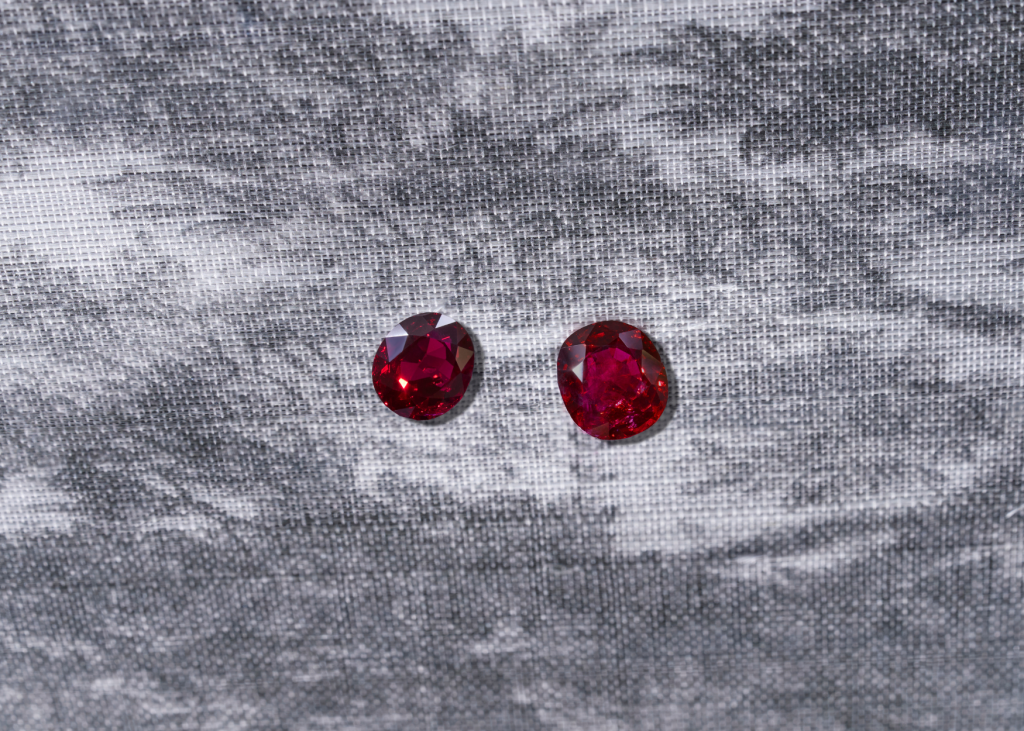
6-carat and 7.5-carat pigeon blood rubies; “Vista 28001” Canvas Linen in Overlook.
Pigeon blood rubies have long been considered the most sought-after (and expensive) of their type, prized for their vivid, saturated red colour, sometimes with a fine tint of purple. A stone can only be called “pigeon blood” if it meets certain criteria, one of them being that it’s untreated.
In a former interview with Boulevard, Dr Daniel Nyfeler, managing director of the Gübelin Gem Lab, explained: “The term ‘pigeon blood red’ was originally coined for rubies from Myanmar, and indeed most pigeon blood red rubies originate from Burma.”
He added, “One additional, important criteria is the presence of distinct fluorescence under both long- and short-wave ultraviolet light. This fluorescence is induced by the presence of small amounts of chromium atoms in the crystal and creates a soft, gentle, but at the same time a very warm and intense red colour—almost glowing.”
Given their scarcity, it’s no surprise that rubies have consistently skyrocketed in price over the years. Says Moe Moe, “It’s very rare to get a huge and dramatic pigeon’s blood ruby, especially one with an intense red colour and one that’s unheated and untreated.”
She adds, “Because of the political situation, the mining areas in Myanmar have been unstable. People don’t see it as worthwhile to continue mining, so production has dropped significantly. Some small, family-run mines are still operating, but the output is very low.”
Demand for coloured stones
When Moe Moe first started collecting gemstones, diamonds were the most sought-after. Today, she’s witnessing market shifts: “Over the last 10–20 years, diamond prices rose sharply. But as market sentiment shifted, people began wanting coloured stones as well—especially once they felt they already had enough diamonds. That shift happened gradually, but since 2022, coloured stones have consistently been in higher demand than diamonds. Of course, coloured diamonds remain highly sought after, but fine rubies, sapphires, and emeralds are now commanding extraordinary prices as well.”
She adds, “Their prices appreciate most reliably. Emeralds, in particular, have a uniquely beautiful green and continue to perform well.
“In the end, if you love gemstones, any natural, untreated stone with good colour and brilliance holds its own beauty and value. But if your goal is purely financial—to see appreciation or resale potential—then focus on the top category: rubies, sapphires, emeralds, and coloured diamonds.”
For those who don’t want to fork out the eye-watering prices for the big four, alternative coloured gemstones are rapidly gaining traction. Says Moe Moe, “Spinels used to be overlooked, but as rubies, sapphires, and emeralds have become more expensive, collectors began exploring spinels as alternatives. They come in a wide range of colours—pink, orange, purple, green, blue—though they often have secondary tones. These secondary hues usually lower the value, so choosing a high-quality spinel requires a very discerning eye.
“Pink and red spinels are particularly rare and valuable. Fine red spinels can even resemble rubies—they’re elegant, luminous, and have a natural sophistication that collectors appreciate.”
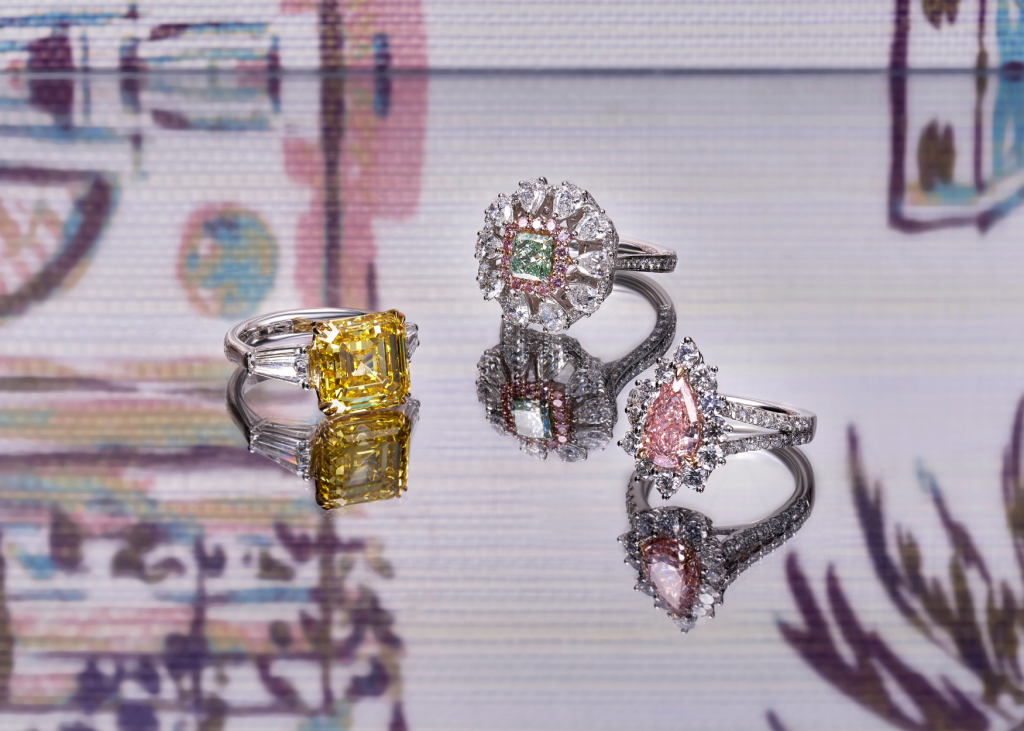
Rings set with a 9-carat vivid yellow diamond, 0.70-carat vivid green diamond and 2-carat intense pink diamond; “Toulouse Toile 28904” Manila Hemp in Blush Bazaar.
She’s also noticed increasing demand for lagoon tourmalines. “‘Lagoon colours—with that vivid bluish-green hue—have also become popular recently. They’ve existed in the market for a long time, but clever branding and marketing have made them more desirable. Once a colour gets highlighted by a major jewellery house, demand rises dramatically.”
Another stone that exploded in popularity in the past decade is Paraiba tourmalines, known for their neon blue hue. They are found only in three mines in the world, and the Brazilian one is almost depleted. However, Moe Moe remains cautious about calling them investment-grade. “They’re beautiful but soft and fragile, so they’re easily damaged and not ideal for investment. Still, they appeal to collectors drawn to their unique colour.”
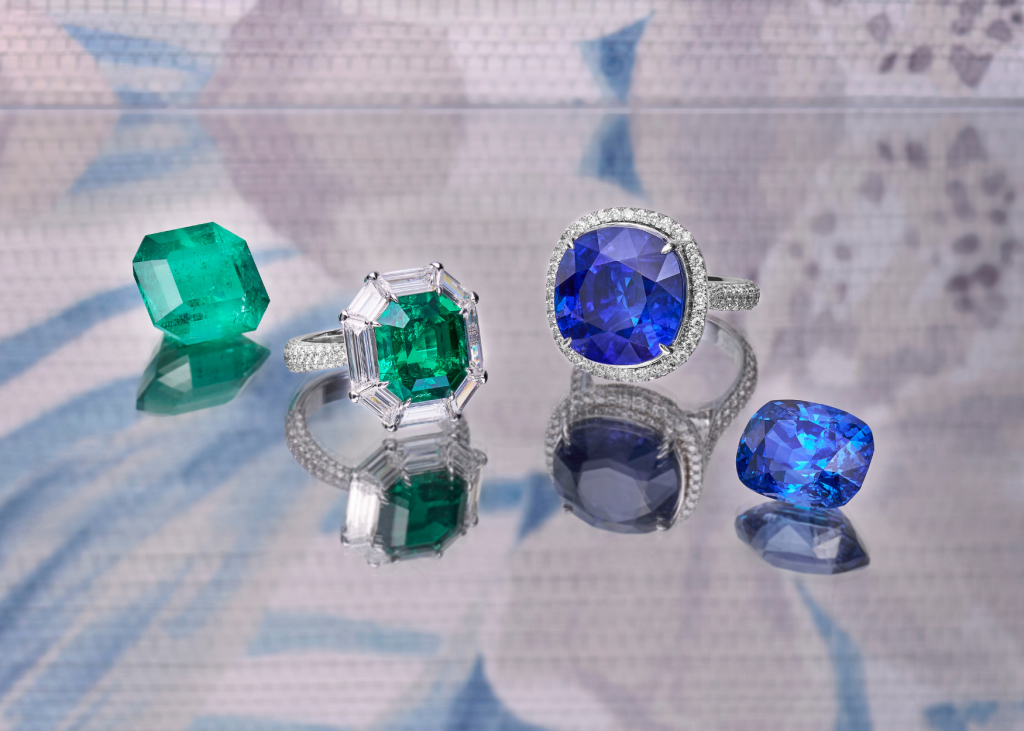
12-carat emerald; ring set with a 5-carat emerald and diamonds; 20-carat sapphire ring; 12-carat sapphire; “Aloha Orchids 10555” woven walls in Malibu Blue.
Beyond the four C’s
The question begs to be asked, however: What makes a coloured gemstone investment-worthy? As their name suggests, colour is the primary criteria when assessing coloured gemstones, followed by clarity. A natural coloured gemstone with no inclusions and that’s eye-clean without any treatment is the holy grail.
But there is another criteria that jewellers look for: “After from the four C’s, there’s one more thing that we call ‘material quality’. Even though the colour might be good, the material might not be as good—this is when pressure and temperature combined make the density of the stone very glassy, shiny and brilliant. Some stones are not formed very well, and remain waxy and not clear. Two colours might be identical, but this ‘material’ quality is what sets them apart.”
“For the perfect stone, you need everything, the material, the cut, the shape, the colour concentration—it must all be combined together. But of course, not everyone is a Miss Universe.”
Read next:
5 bed POA
Belmont Road, D10 5 bed 43,800,000 SGD

3-4 bed | 2,702 - 8,923 area POA
4+1 bed 20,000,000 USD
4 bed POA