Who will shape the future of Pagani Automobili? We speak to Christopher Pagani, Horacio’s second son and potential heir
by Jamie Nonis
Photography by Jin Cheng Wong
If you ever ran into Horacio Pagani and son Christopher on their travels around the world, you’d probably never guess that the pair run a modest family empire with a billion-dollar valuation. Unless you’re a hardcore petrolhead, of course.
And therein lies the paradox that about sums up the endearing charm of this father-son duo. Unassuming and always a picture of understated elegance, they’re the epitome of quiet confidence. A palpable sense of gravitas from the septuagenarian in place of airs. And in place of pretension, a fastidious devotion to craft and quality—the very kind reflected in the rear-view mirrors of Pagani hypercars.
Every Pagani is a glorious work of automotive art that sells for no less than several million dollars (before taxes). And, quite frankly, looks more at home in a private museum or a billionaires’ car gallery than on the roads. But, rest assured, pure show ponies they are not.
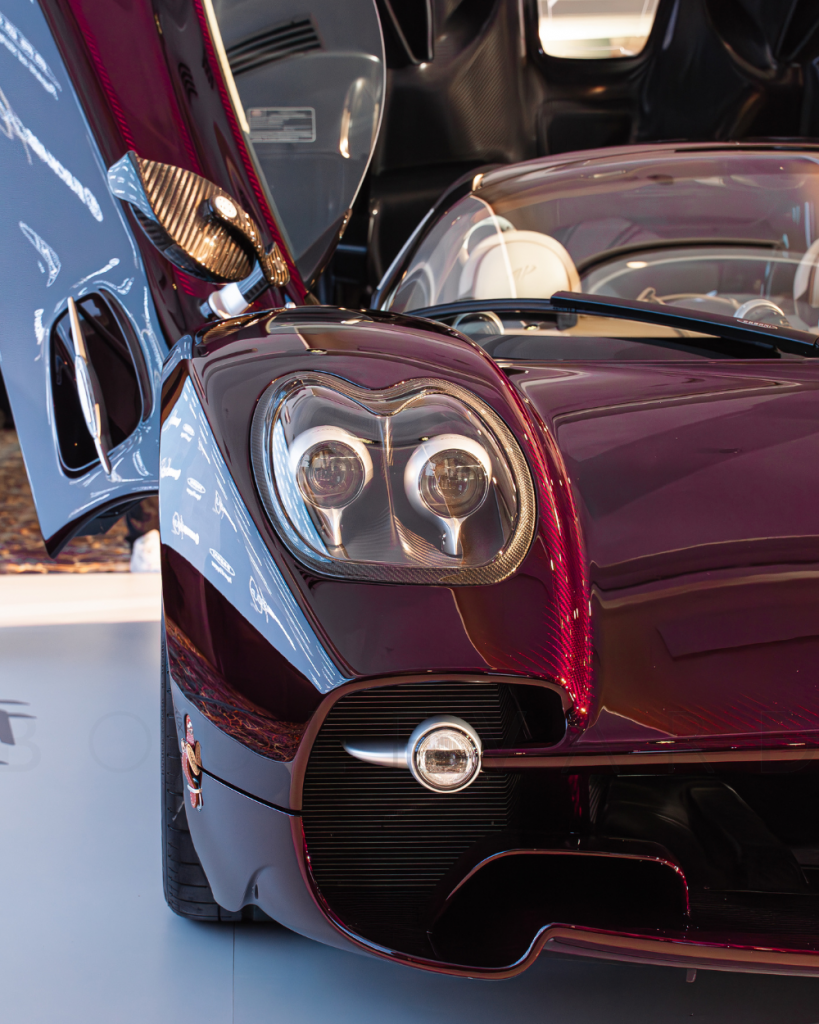
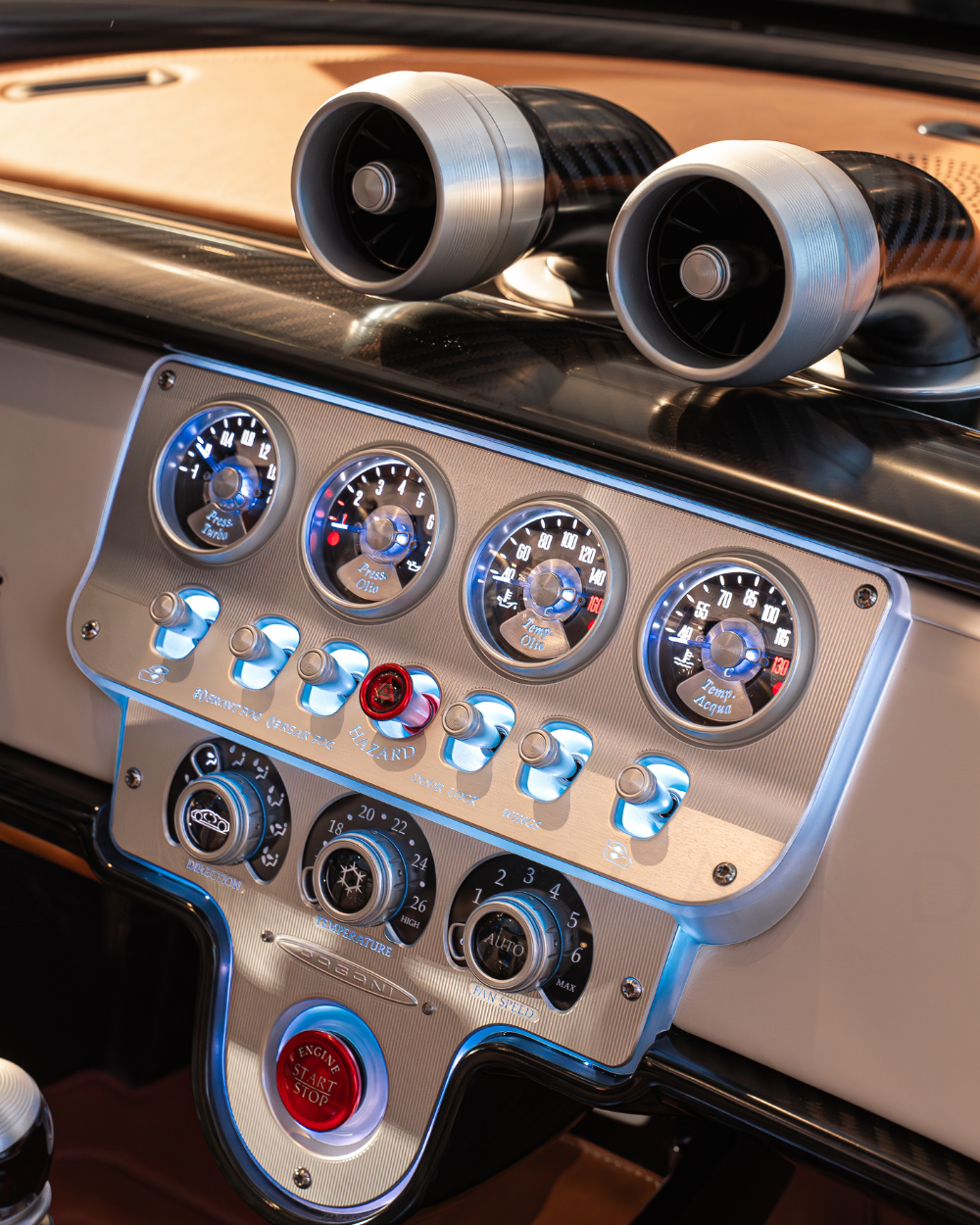
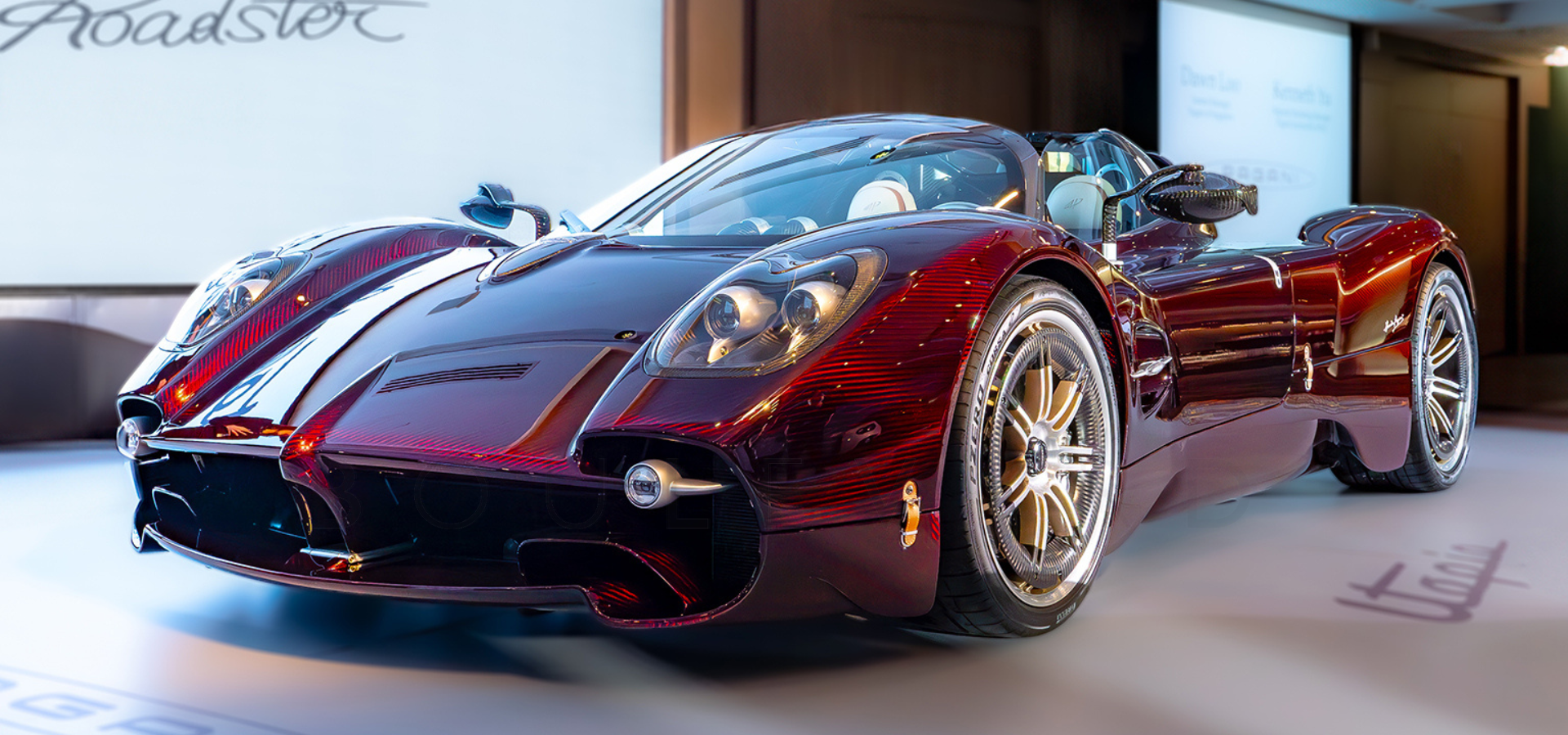
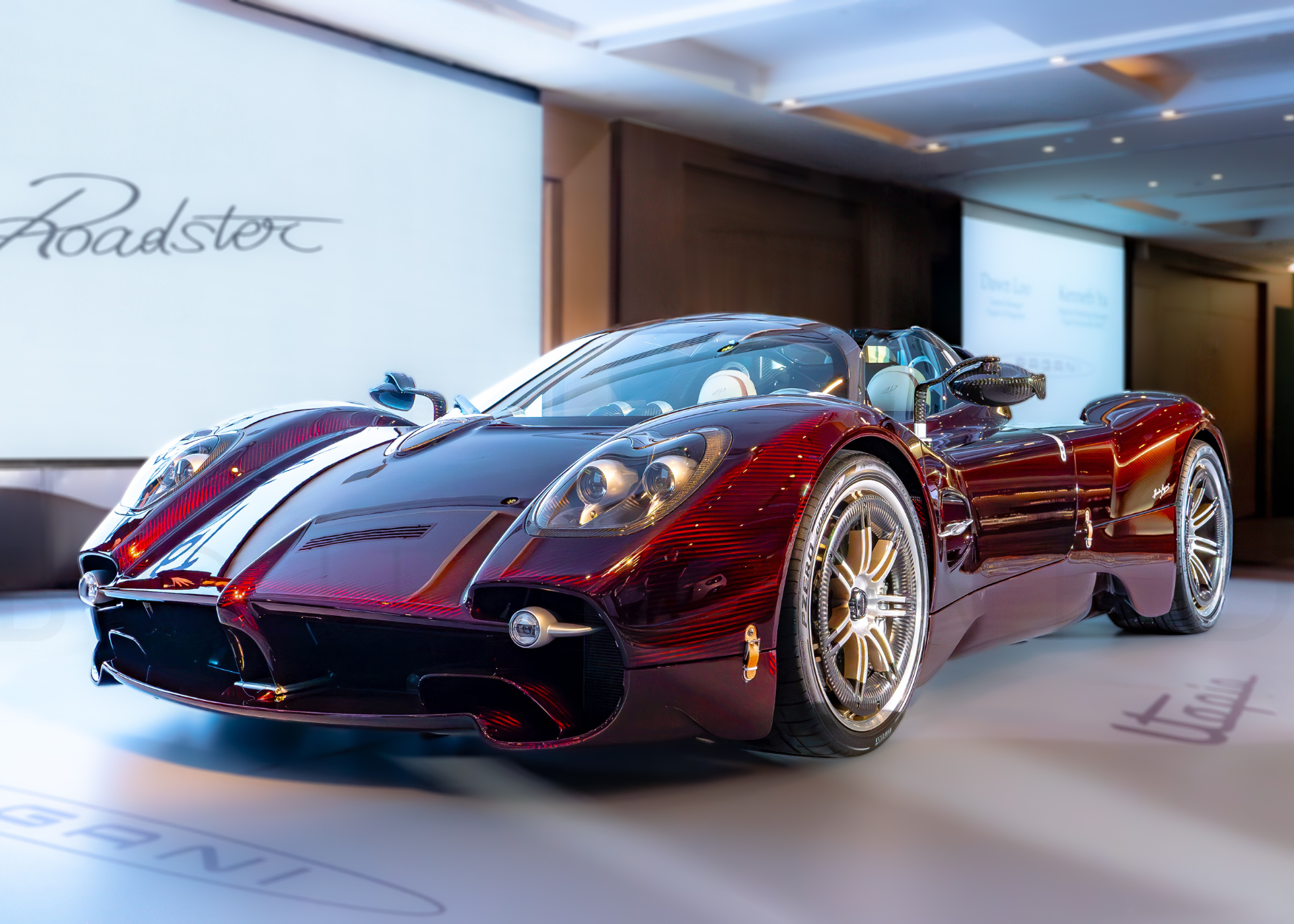
The Pagani Utopia Roadster is limited to 130 units (top), featuring doors with elegant butterfly kinematics and bespoke Pirelli Cyber tyres with advanced sensor technology (left), while inside the cabin, an analogue display adorns the dashboard (right) that resembles a luxury watch.
In the automotive arena, the Pagani name is the stuff of legend. Horacio Pagani is often described in motoring mythology as the godfather of the hypercar. It was the debut of the Zonda at the 1999 Geneva Motor Show that apparently led journalists in attendance to coin a new term: the hypercar. It referred to an automobile so extraordinary in both beauty and power that it superseded even the supercar.
With production capped at about 60 cars a year, every Pagani that has rolled out of Modena in the 27 years since has been a rare, highly-prized, limited edition—if not bespoke—model. Each one speaking a language that only true car collectors and those who love the thrill of a high-performance machine comprehend.
On the fast track
Clad in a varsity-style jacket paired with ubiquitous blue jeans—workhorse of the everyman—and white trainers, Pagani senior arrives at the Fuji Speedway circuit in Japan accompanied by Christopher, his right-hand man and dutiful translator on these worldwide travels.
We’re here for the fourth and final ‘Arte in Pista’ (Art of Track) of 2025—private track days at various motor circuits across the globe staged for Pagani clients to experience their hypercars at peak performance on track. Organised since 2021 in parallel with the launch of the Huayra R, these exclusive track events are offered only to owners of select Pagani models such as the Zonda R, Zonda Revolución, Huayra R, and Huayra R Evo.
When a customer buys a Pagani, they receive anywhere from five to 30 ‘tokens’ (depending on the model) that buy them access to the equivalent number of these private track days. A Huayra R, for example, gets you five tokens while the Huayra R Evo Roadster earns you 10.
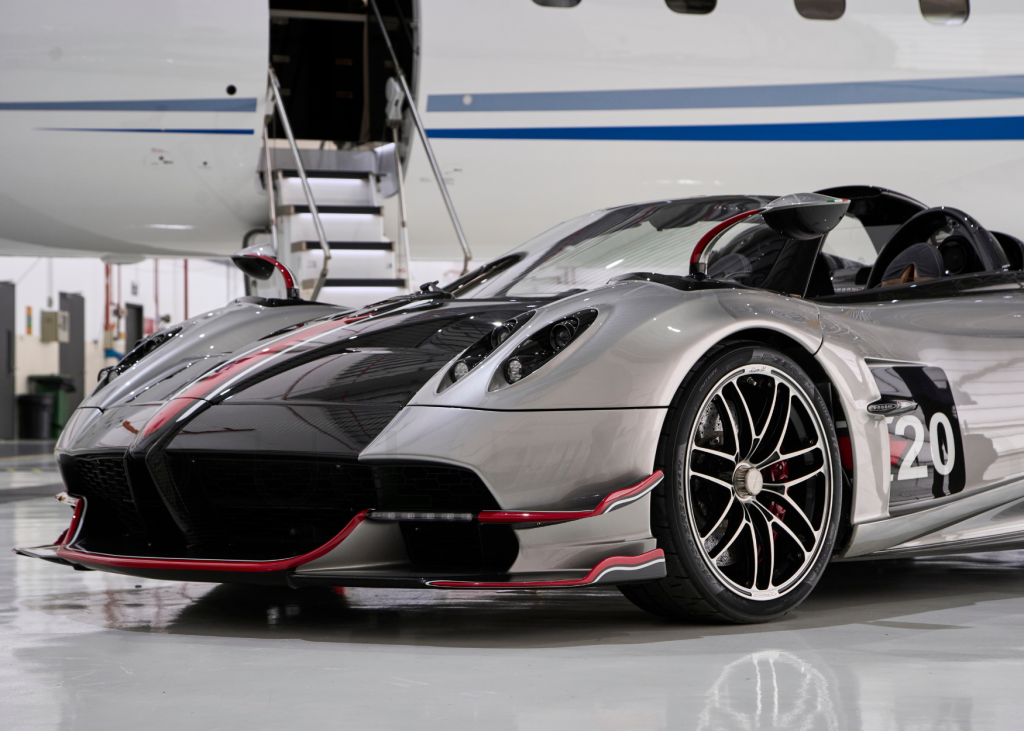
The Huayra Roadster BC is limited to just 40 models worldwide, featuring an open-top silhouette paired with cutting-edge technology.
Today, 11 Pagani owners of diverse nationalities have gathered to drive their own magnificent machines on track against the spectacular backdrop of Mount Fuji—many of them with partners and kids in tow. Their cars have been flown into Japan specially for the event, and then it’s back to the Pagani headquarters in Italy for servicing and maintenance, where they can be stored until the next track day.
Staging each Arte in Pista is a mega-production comprised of a full technical team of professional motorsport drivers, mechanics, race engineers, and a technical director for data analysis. There’s even a physiotherapist and a motorsport-specific nutritionist for a total of 66 staff to support these customer-drivers.
Clients also have the option of booking fully bespoke, one-on-one track sessions where Pagani handles all the logistics of flying in the necessary software and hardware described above, just as a customer in the Middle East had previously requested.
Then, there’s the ultra-rare privilege that only attending one of these extremely intimate track days can buy: Facetime with the man, the myth, the legend himself—Horacio Pagani—throughout the weekend.
Beauty beyond the auto
It’s a chilly November weekend in late Japanese autumn, with the mercury hovering in the single digits, and it’s the third time I’m meeting Horacio Pagani in person.
Having interviewed the Argentinian-born patriarch who converses mostly in Italian twice before, I decide it’s time the spotlight shifted to second scion Christopher. As head of marketing at Pagani Automobili, he leads a team of 30, oversees public relations for the brand, and is responsible for developing dealer networks around the world.
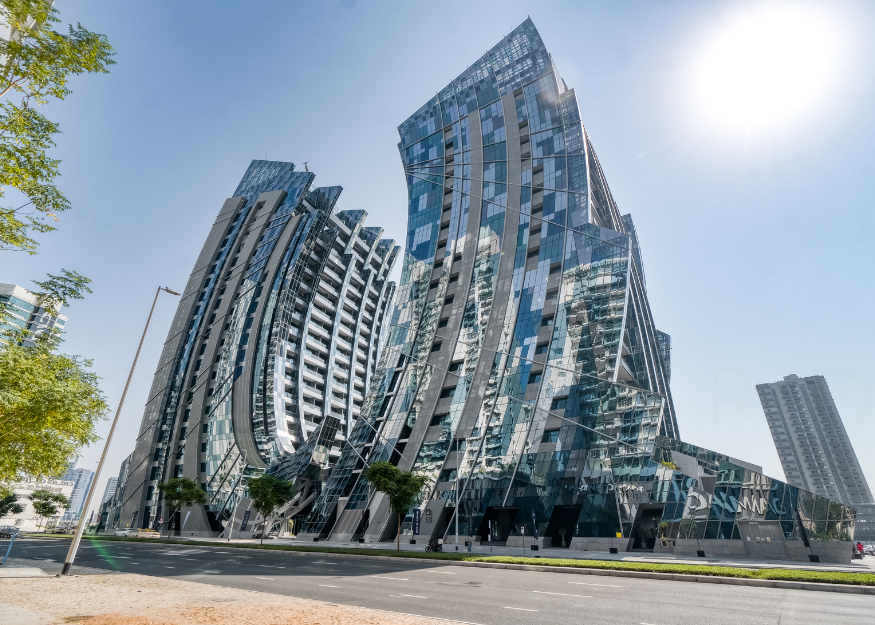
The Pagani Residences Miami consists of luxurious 2- to 4-bedroom apartments and penthouses, with design inspired by Pagani hypercars.
Elder brother Leonardo, meanwhile, has a more design-oriented role within the Pagani Arte division, which takes on non-automotive projects for clients in sectors such as aviation and real estate. The Pagani Residences Miami, for instance, is one such project under his purview. The 30-storey residential tower is situated on the upscale Harbor Island in North Bay Village, with sweeping waterfront views overlooking Biscayne Bay.
Slated for completion by 2028, it’s the first residential project in the world where both the exterior and interior of the building are developed and curated in such close collaboration with Pagani Arte, with furnishings to reflect the same exacting standards of craftsmanship you expect of a Pagani automobile.
“If a buyer is interested, they can also work with our team to fully furnish the apartment with Pagani Arte items as part of the Pagani lifestyle,” Christopher explains.
Preserving a legacy
Growing up in the car capital of Modena in northern Italy, you could say that the brothers’ destiny was somewhat pre-ordained.
Summer holidays were spent tinkering away in the Pagani atelier, trying their hands at everything from installing engines and machining carbon fibre components to working in the logistics and events departments.
Coming of age in the epicentre of Italian automotive engineering also meant that studying mechanical engineering at a local technical school was a rite of passage for the brothers. After graduating,
Christopher enrolled at the University of Modena to pursue business and economics while Leonardo went on to study car design.
“We could do two universities at the same time,” Christopher recalls. “You go to class and then you can help out in the family business in the afternoons.”
Of the two brothers, Christopher’s yearning for adventure brought him to California, where he helped grow the North American business. “I’m very keen to learn about new cultures, and I accepted the challenge of leaving my comfort zone. It was not easy, but I loved it.”
The office was later moved to Miami to be closer in timezone to Pagani’s Italian headquarters. The Miami location was also geographically closer to South America, and would therefore provide a better base for future expansion into markets such as Mexico, Brazil and Chile.
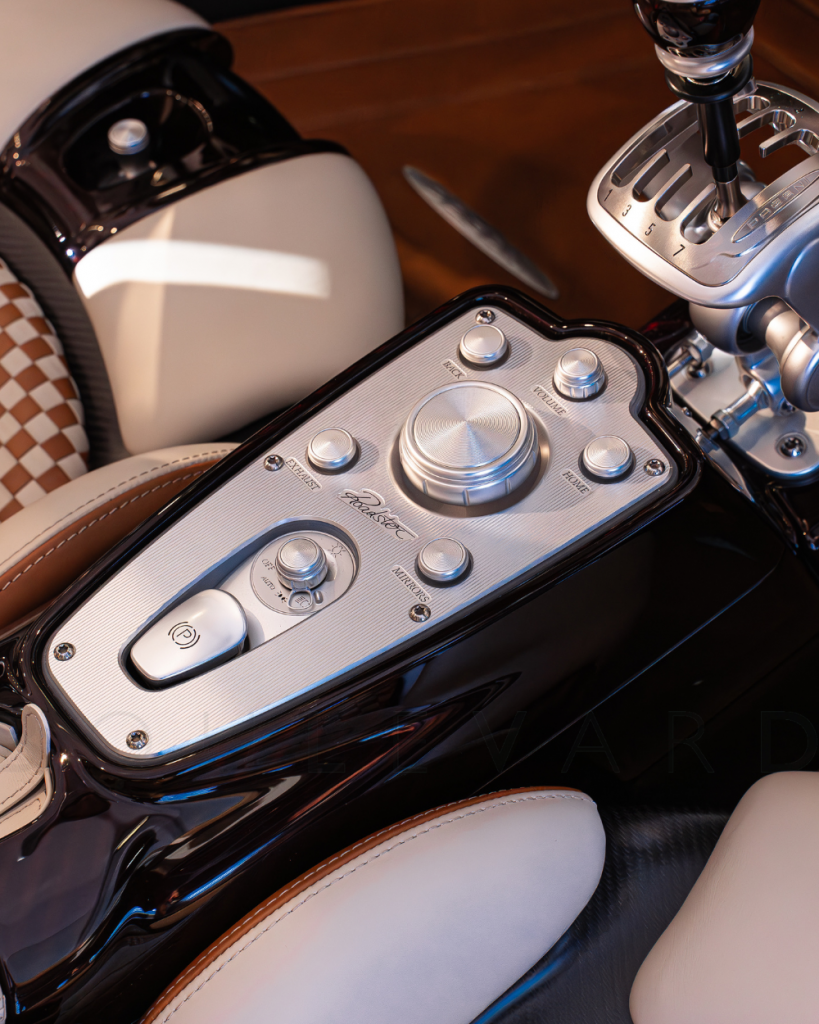
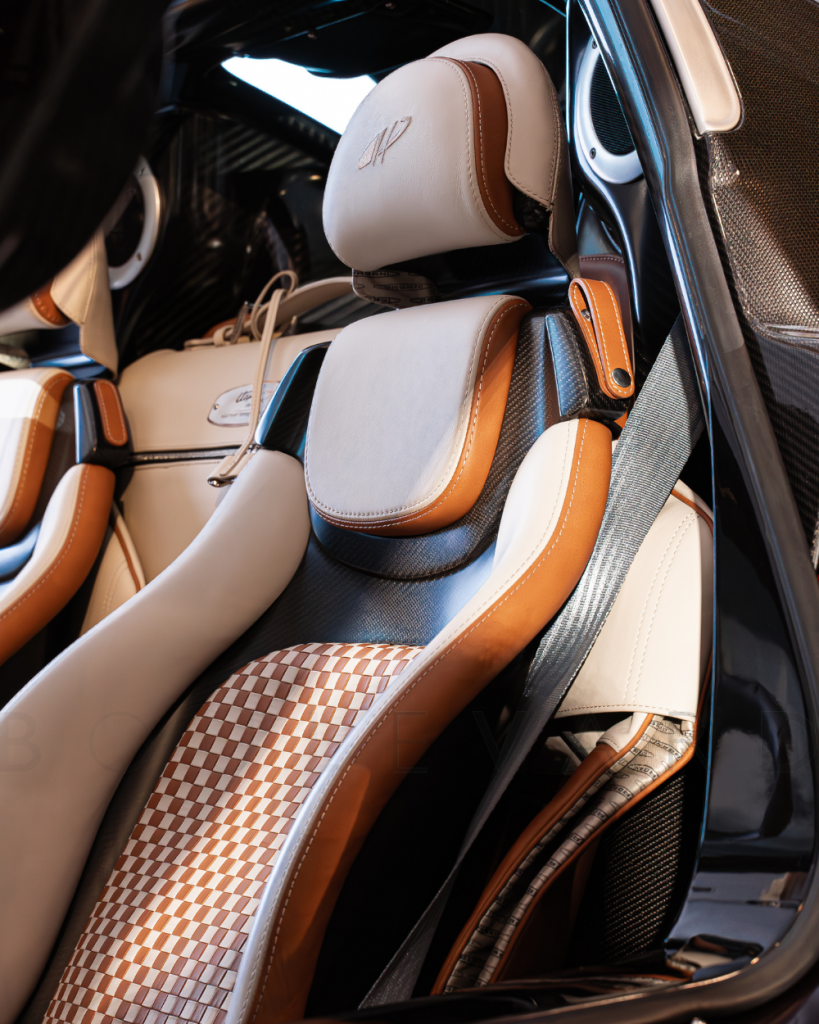
The Utopia Roadster’s automated manual transmission (left) and bespoke leather interiors (right).
In 2022, Christopher returned to his father’s side in Italy. What is it like working with a living legend who also happens to be your father?
“It’s like going to university with him every single day,” Christopher quips. “He likes to have feedback—and he does listen to it. He also wants us to be part of the decision-making.”
Naturally, working with the Pagani founder is also “very demanding”. One simply would not be able to construct such universally revered hypercars otherwise. “He’s a very precise person; very consistent, and his attention goes into every single detail,” he shares.
Inspired by his hero, Leonardo da Vinci, Horacio continues to be a student of life, constantly soaking up information and inspiration across all fields. “He wears many different hats, and he’s such a complete person in that he can take care of everything from engineering and design to financial, economic and marketing topics. He’s teaching us a lot, and we are trying to absorb as much as we can,” adds Christopher.
Despite its size, the company very much revolves around the creative figure of Horacio. So as for the small matter of who will take over when dad eventually steps back from the business, Christopher confirms that it’s a decision that’s yet to be made.
“We feel this responsibility of making sure that what my parents have created is not destroyed in the future; there’s a lot to protect,” says the 37-year-old, who’s a year younger than brother Leonardo (named after da Vinci, of course).
“[As a family], we talk about it in a way that it’s results that guide decisions, not emotions. So if you bring the result, you may be capable of being the next [CEO],” he says. “We’ve been in the company from the beginning and we have a way of looking at things that’s very similar to my parents. We believe we can make the right decisions, but we have not decided who it is going to be—or if it’s going to be either of us.”
After all, you never stop learning with Horacio Pagani for a father.
Read next:
5 bed POA
Belmont Road, D10 5 bed 43,800,000 SGD
3-4 bed | 2,702 - 8,923 area POA
4+1 bed 20,000,000 USD
4 bed POA